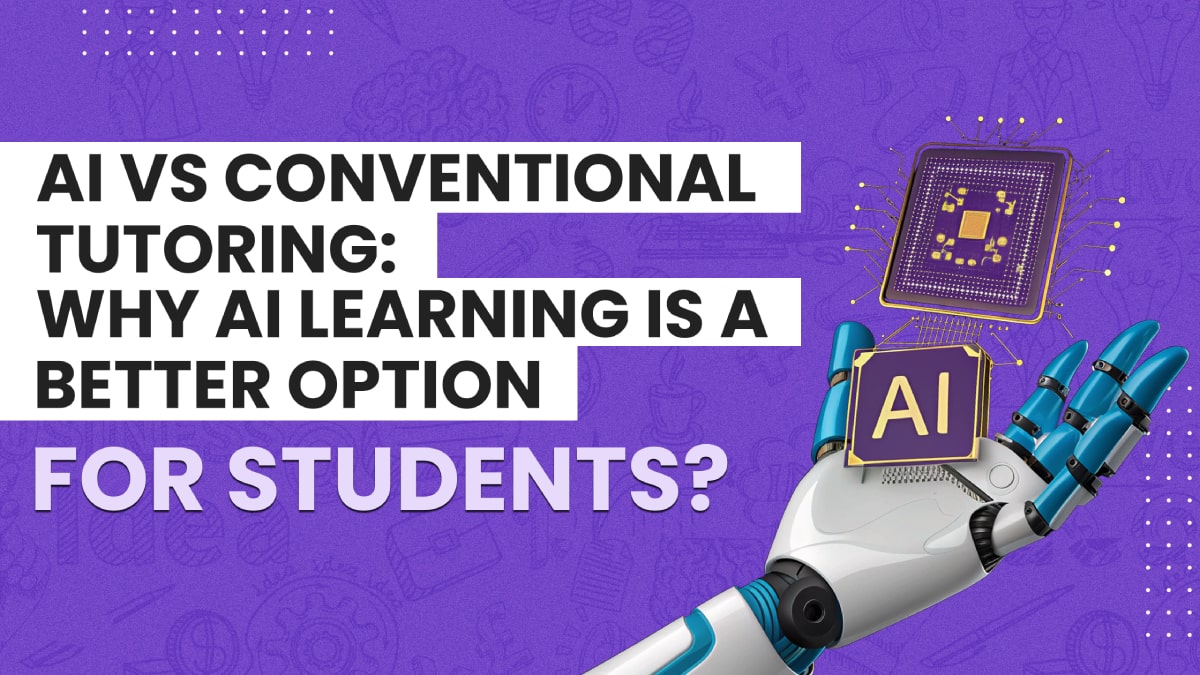
Education is changing rapidly. A few years ago, students depended completely on schools and tuition classes to clear doubts. Today, with Artificial Intelligence (AI), students can ask questions anytime and get instant answers. This shift has created an important question for students and parents: Is AI-based doubt solving better than traditional tuition? Or is traditional tuition still more effective?
The truth is not about choosing one over the other. It is about understanding how both work and how they can complement each other. In this detailed blog, we will explore AI-based doubt solving and traditional tuition in simple, humanized language. We will also understand how platforms like Suganta Tutors, which offer structured tuition classes, experienced teachers, and well-prepared notes, help students achieve the best results.
Understanding AI-Based Doubt Solving
AI-based doubt solving refers to using smart digital tools where students can type or upload their questions and get instant explanations. These tools can solve mathematics problems, explain science concepts, summarize chapters, and even improve writing skills.
For example, when a student struggles with a quadratic equation like:
ax2+bx+c=0ax^2+bx+c=0ax2+bx+c=0
aaa
bbb
ccc
-10-8-6-4-224681020406080100-2.002.00
An AI tool can immediately show step-by-step solutions. It explains how the formula works and how to substitute values properly. This instant support reduces frustration.
AI tools are available 24/7. Whether it is early morning or late at night, students can clear doubts without waiting for the next class.
However, AI tools give answers based on patterns and data. They may not always understand the exact level of the student or the specific board exam pattern.
Understanding Traditional Tuition
Traditional tuition refers to learning from real teachers, either offline or online, in structured tuition classes. Students attend regular sessions, interact with teachers, and receive personalized guidance.
The biggest strength of traditional tuition is human understanding. Experienced teachers observe students carefully. They notice if a student looks confused, distracted, or anxious. They adapt teaching methods accordingly.
For example, when teaching the Pythagorean theorem:
a2+b2=c2a^2+b^2=c^2a2+b2=c2
aaa
bbb
c=a2+b2≈21.21c = \sqrt{a^2 + b^2} \approx 21.21c=a2+b2≈21.21
a2+b2=c2≈225.00+225.00=450.00a^2 + b^2 = c^2 \approx 225.00 + 225.00 = 450.00a2+b2=c2≈225.00+225.00=450.00
abc
A teacher may draw diagrams, give real-life examples, and ask questions to ensure students truly understand. This interactive environment builds deeper clarity.
Platforms like Suganta Tutors provide structured tuition classes guided by experienced teachers who understand board exam patterns and marking schemes. They also provide well-organized notes that simplify revision.
Speed vs Understanding
AI-based doubt solving is fast. You ask a question and get an answer instantly. This is very helpful when students are practicing at home and get stuck.
Traditional tuition, on the other hand, focuses on deep understanding. Teachers do not just give answers; they explain why something works. They correct mistakes and ensure concepts are clear.
For example, when learning Newton’s Second Law:
F=maF=maF=ma
An AI tool can explain the formula quickly. But a teacher can connect it to real-life examples like pushing a bicycle or carrying a heavy bag, making it easier to remember.
The ideal approach is to learn concepts in tuition classes first and then use AI for quick revision and extra practice.
Personal Attention vs Automation
AI treats every student in a similar way. It gives explanations based on algorithms. While it is helpful, it cannot fully understand emotions, stress, or learning speed.
Traditional tuition, especially through platforms like Suganta Tutors, offers personal attention. Experienced teachers can guide weak students differently and challenge strong students with advanced problems.
They also provide structured notes that focus on exam-relevant content, saving time and reducing unnecessary stress.
Exam Strategy and Presentation
Board exams require more than just knowledge. Presentation matters. Format matters. Time management matters.
AI tools may solve a math problem correctly but might not always follow the exact board exam format.
For example, in applied mathematics, understanding compound interest is important:
A=P(1+r/n)ntA=P(1+r/n)^{nt}A=P(1+r/n)nt
PVPVPV
r (%)r\,(\%)r(%)
nnn
24681012141618205001000150020002500$2,653.30
AI can calculate answers quickly, but experienced teachers in tuition classes explain how to write steps clearly to score full marks.
Suganta Tutors ensures students follow correct formats, understand marking schemes, and practice exam-oriented questions.
Notes and Structured Learning
AI tools can generate summaries, but they may sometimes include extra information not required for exams.
Traditional tuition provides focused notes prepared by experienced teachers. These notes highlight important topics and commonly asked questions.
Suganta Tutors offers well-organized notes that help students revise quickly before exams. This structured content reduces confusion and improves confidence.
Motivation and Discipline
One major difference between AI-based doubt solving and traditional tuition is motivation.
AI cannot push students to study regularly. It cannot notice if a student is losing focus.
Teachers in tuition classes encourage students, monitor progress, and guide them emotionally. They build discipline and consistency.
Students preparing with Suganta Tutors benefit from structured classes that create a proper study routine.
Cost and Accessibility
AI tools are often affordable or even free. They provide easy access to learning resources.
Traditional tuition may require fees, but the value comes from personal guidance, exam strategies, and structured notes.
When students invest in quality tuition classes with the best tutors, they receive mentorship that AI cannot replace.
The Ideal Combination
The debate should not be AI vs Traditional Tuition. The real question is how to combine both effectively.
Students should:
Learn concepts from experienced teachers in tuition classes.
Use AI tools for extra practice and doubt solving.
Revise using structured notes.
Attempt mock tests independently.
Review mistakes with teachers.
Platforms like Suganta Tutors make this combination powerful by offering strong academic support along with flexibility.
Real-Life Example of Balanced Preparation
Imagine a Class 12 commerce student preparing for accountancy.
They attend regular tuition classes at Suganta Tutors, where the best tutors explain journal entries and balance sheets.
After class, the student practices questions at home. If stuck, they use AI tools for clarification.
Before exams, they revise using organized notes from Suganta Tutors.
This balanced approach ensures clarity, speed, accuracy, and confidence.
Which One Should You Choose?
If a student depends only on AI, they may get quick answers but miss exam strategy and presentation guidance.
If a student depends only on tuition but does not practice independently, they may lack speed.
The smartest students combine both.
AI reduces small doubts instantly. Traditional tuition builds foundation and exam readiness.
Suganta Tutors offers the right environment with experienced teachers, structured tuition classes, and effective notes to support students completely.
Final Thoughts
Education is evolving. AI-based doubt solving is a powerful tool, but it cannot replace human guidance. Traditional tuition provides mentorship, discipline, and exam-focused preparation.
The best approach is balance.
Use AI for speed.
Use tuition classes for depth.
Use structured notes for revision.
With guidance from the best tutors at Suganta Tutors and smart use of AI tools, students can achieve excellent results without unnecessary stress.
Frequently Asked Questions (FAQs)
Many parents wonder whether AI can completely replace tuition classes. The honest answer is no. AI can solve doubts quickly, but it cannot provide emotional support, exam strategies, or personalized mentoring like experienced teachers.
Students also ask whether AI is enough for board exams. AI is helpful for practice and revision, but structured tuition classes are essential for understanding exam patterns and scoring techniques.
Some students worry about cost. AI tools may seem cheaper, but investing in quality tuition classes with the best tutors ensures long-term academic success.
Parents often ask how Suganta Tutors helps differently. Suganta Tutors offers experienced teachers, structured notes, exam-oriented teaching, and regular performance tracking, which builds confidence and clarity.
Finally, students ask how to balance both systems. The best method is to learn from tuition classes first, then use AI tools for extra practice and quick doubt solving.
In conclusion, AI-based doubt solving and traditional tuition are not competitors. They are partners. When used wisely together, they help students move from confusion to confidence and from average performance to academic excellence.