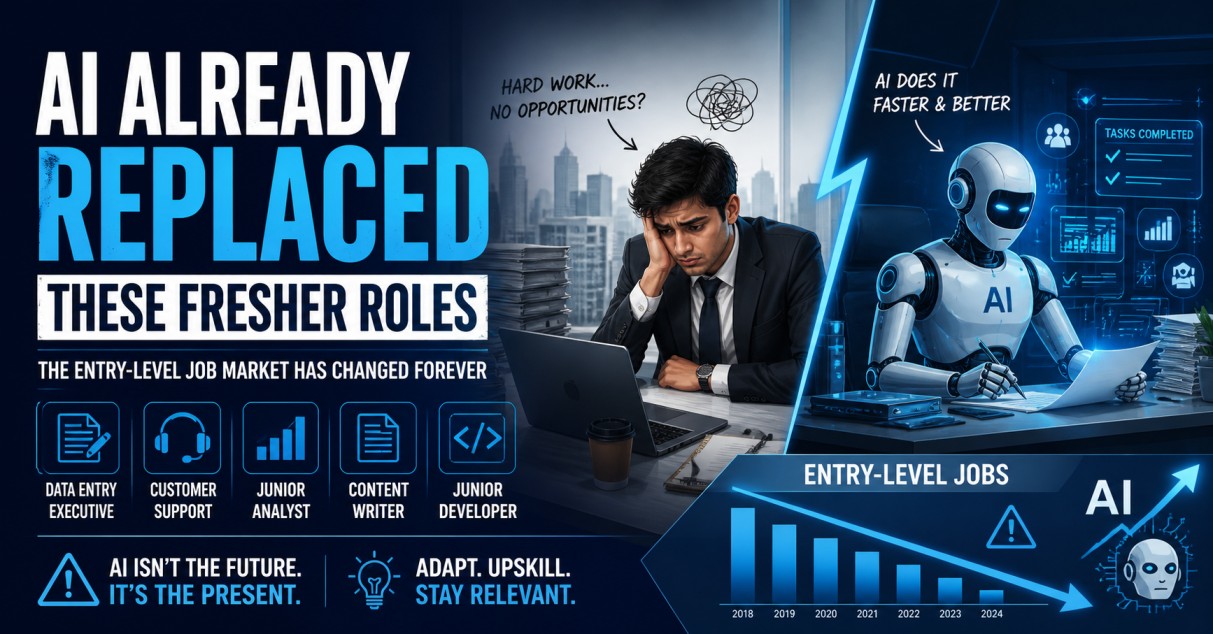
While these shifts may yield short-term cost savings, they create a “missing rung” in the career ladder: without entry-level training, companies risk talent shortages and burnout at senior levels. This article identifies the key entry-level roles already replaced or sharply reduced by AI, cites real-world cases and studies, and lays out concrete reskilling paths for affected graduates (with 3-, 6-, and 12-month learning steps). A summary table compares impacted roles, technologies used, evidence levels, and recommended new careers. Finally, short CTAs and FAQs guide freshers on adapting. The goal is to provide a thorough, data-backed guide to navigating an AI-transformed job market.
Which Entry-Level Roles Have Been Automated by AI?
Customer Service Representatives (Fintech, Retail, BPO)
Routine customer-support tasks have been a prime target for AI. Companies are deploying chatbots and virtual assistants (often powered by GPT-like models) to handle FAQs, order status, and basic troubleshooting. For instance, Klarna (a Swedish fintech) dramatically cut its customer-service workforce by relying on an AI chatbot that initially handled 700 rep workloads. Similarly, Dukaan’s CEO publicly admitted replacing 90% of live chat agents with AI. Gartner even predicts that ~80% of customer-service organizations will use generative AI by 2025, automating their first-tier support. Tasks replaced: fielding common inquiries, processing refunds/returns, data lookups. Tech used: AI chatbots (OpenAI/Google/IBM bots), RPA tools. Evidence level: High (major company cases and surveys).
Reskill path: Pivot to “AI-augmented support” or customer-success roles that oversee AI. Focus on communication skills + technical know-how (e.g. Udemy “AI in Customer Support” course). In 3–6 months, complete a “Customer Service & AI” certificate; by 12 months, upskill in data analysis or product knowledge to become a technical support specialist.
Content Writer / Copywriter (Marketing, Media)
Content creation roles have been deeply impacted by generative AI. Entry-level copywriters once churned out blog posts, social media copy, and product descriptions – tasks now often generated by GPT models. Marketing agencies report needing fewer junior writers when senior staff have AI drafting and editing tools. For example, large media outlets like BuzzFeed shifted toward AI-generated content in 2023, leading to layoffs of junior writers. Tasks replaced: drafting articles, basic SEO copy, newsletter writing. Tech used: LLMs (ChatGPT, Jasper) for drafting and editing. Evidence level: Medium (industry reports and anecdotal layoffs). Graduates note drastically fewer “Content Writer” postings since AI tools emerged.
Reskill path: Emphasize strategic and analytical skills. In 3–6 months, take courses in digital marketing or SEO strategy (e.g. Google Digital Marketing Certificate) and learn AI prompt engineering. By 12 months, build expertise in content strategy, UX writing, or video production (market demand still high). For example, a Coursera course on AI For Everyone (Ng) plus an SEO specialization prepares juniors to supervise AI-generated content.
Data Entry / Junior Data Analyst (Finance, Business)
Anything involving repetitive data tasks is ripe for automation. Basic data-entry clerks and junior analysts who formatted spreadsheets, compiled reports or ran routine queries have seen their roles shrink. AI/automation tools (from OCR to Python scripts) can extract and validate data far faster. Tasks replaced: manual data entry, simple reporting, basic data cleaning. Tech used: AI/ML data extraction tools, low-code RPA (UiPath), ChatGPT for ad-hoc analysis. Evidence level: Medium (widely acknowledged trend, backed by Revelio finding that “highly AI-exposed” entry roles fell ~40%). Many finance departments use AI for invoice processing or reconciliation, cutting clerical jobs.
Reskill path: Move toward data science or analytics. Within 3–6 months, complete courses like Google Data Analytics Professional Certificate or IBM’s Data Science certificate to master Python/R and SQL. By 12 months, target “Data Analyst” or “Data Scientist” roles: take a Udacity or Coursera nanodegree in machine learning, and build a portfolio (Kaggle, data-visualization projects).
Research Assistant / Junior Analyst (Consulting, Legal, Academic)
Entry-level analysts and research assistants traditionally gathered information, combed documents, or summarized cases for senior consultants and attorneys. Now, generative AI can automate much of that “grunt work.” For example, law firms use LLMs to draft case summaries, and consulting firms pilot AI to scan market data. Tasks replaced: literature review, report drafting, database searches. Tech used: LLMs (ChatGPT/GPT-4 with legal plug-ins), AI-driven search tools. Evidence level: Medium (industry commentary and early pilots). A senior consulting manager notes that routine research tasks are increasingly done by AI.
Reskill path: Leverage domain expertise with data skills. In 3–6 months, study research methodology and AI tools specific to your field (e.g. legal tech certificates, business analytics courses). In 12 months, aim for “Business Analyst” or “Data Scientist” roles in the same industries, taking courses like Machine Learning by Stanford (Andrew Ng) or specialized programs (e.g. financial modeling or legal analytics).
Software Engineer / IT Support (Tech Industry)
Contrary to headlines, AI hasn’t fully replaced junior developers, but it’s transforming their tasks. AI coding assistants (e.g. GitHub Copilot) now auto-generate boilerplate code and help debug, meaning entry-level programmers focus less on writing basic functions. Surveys show 84% of software developers use AI tools by 2025. Also, tech hiring platforms report ~20% fewer jobs for 22–25-year-old devs (Stanford analysis). Many companies are freezing intern hires to let AI handle simpler work. Tasks reduced: writing starter code, simple bug fixes, documentation. Tech used: AI-assisted coding (Copilot, ChatGPT, Codex). Evidence level: Medium (developer surveys and hiring data).
Reskill path: Embrace AI in tech. Quickly learn AI/ML frameworks: within 3 months, complete Python and ML basics (e.g. Fast.ai). By 6 months, build projects using PyTorch/TensorFlow and learn cloud platforms (AWS/Azure AI). In 12 months, pursue roles like AI Developer or Machine Learning Engineer through courses (e.g. Udacity AI Engineer Nanodegree) and certifications (AWS Certified ML).
Graphic Designer (Marketing/Creative)
Midjourney, DALL·E and other generative art tools have automated the creation of simple graphics. Entry-level designers who produced routine social media banners, logos, or webpage mockups now often use AI tools to speed up drafts. Tasks replaced: basic concept art, social graphics, simple layouts. Tech used: Generative AI (Midjourney, Adobe Firefly). Evidence level: Low-Medium (the shift is recent; some studios report fewer junior positions). Many senior designers now employ AI as a tool, but fewer firms hire as many junior designers for routine tasks.
Reskill path: Focus on high-value creative skills. In 3–6 months, learn advanced design tools and UX/UI principles (e.g. take a UX design course on Coursera or Udemy). In 12 months, explore emerging fields like AR/VR design or product design, perhaps via specialized courses (e.g. Unity or Adobe XD bootcamps). Building a strong portfolio with AI-enhanced designs will make you indispensable.
HR/Recruitment Coordinator (Corporate Back Office)
AI is increasingly used in HR departments for resume screening and onboarding. IBM, for example, announced pausing hiring for ~7,800 roles (especially HR and admin jobs) that could be replaced by AI. Simple tasks like scheduling interviews, sorting candidates, or routine HR queries can be automated. Tasks replaced: resume pre-screening, scheduling, basic HR inquiries. Tech used: AI hiring platforms (Oracle Taleo with AI, chatbots for HR). Evidence level: High (Reuters report on IBM).
Reskill path: Move into HR analytics or strategic HR. In 3–6 months, get certified in HR fundamentals (e.g. SHRM-CP or LinkedIn’s Talent Strategy course). Learn data analysis (Excel, Tableau) to specialize in HR Analytics. Within a year, aim for roles like HR Business Partner or HR Data Analyst, leveraging courses on people analytics or a part-time MBA if possible.
Table: Impacted Entry-Level Roles & Reskilling Paths
| Role | Industry | Tasks Replaced by AI | Tech Used | Evidence | Suggested Reskill Path | Timeframe |
|---|---|---|---|---|---|---|
| Customer Service Rep | Fintech, Retail | Answering queries, processing refunds, basic troubleshooting | AI chatbots (GPT-style), RPA | High (Klarna, survey) | Upskill in customer success & AI tools; take chatbots/communication courses | 3–6–12 mo |
| Copywriter / Content Writer | Marketing, Media | Drafting blog posts, product copy, social media content | Generative AI (ChatGPT, Jasper) | Medium (industry reports, shift to AI content) | Learn digital marketing strategy, SEO, AI prompt engineering; content strategy certification | 3–6–12 mo |
| Research Assistant | Consulting, Legal, Academia | Document review, summarizing, data gathering | LLMs (GPT-4, legal AI tools) | Medium (industry commentary) | Build domain + analytics skills; courses in research methods and AI tools in your field | 3–6–12 mo |
| Data Entry / Junior Analyst | Finance, Business | Data entry, basic reporting, query generation | AI/ML data extraction, RPA, Python scripts | Medium (analyst trends, job postings decline) | Train in data science: Python/SQL courses, Google Data Analytics cert | 3–6–12 mo |
| Junior Software Engineer | Tech, IT Services | Writing boilerplate code, simple bug fixes | AI code assistants (Copilot, ChatGPT) | Medium (Stanford data, industry surveys) | Learn AI/ML development: Python, ML frameworks, cloud certifications | 3–6–12 mo |
| Graphic Designer | Marketing, Design | Creating routine graphics, social media banners | AI art generators (Midjourney, DALL·E) | Low-Medium (emerging trend) | Specialize in UX/AR/VR design; advanced creative tools courses | 3–6–12 mo |
| HR/Recruiter Coordinator | Corporate | Screening resumes, scheduling interviews, admin tasks | AI hiring platforms, chatbots | High (IBM report) | Pivot to HR analytics or talent strategy; SHRM or HR analytics courses | 3–6–12 mo |
What Freshers Can Do Now (CTAs)
- Reskill Today: Enroll in AI, coding or data analytics courses now to stay competitive!
- Embrace AI: Start learning AI tools (ChatGPT, data platforms) and highlight those skills on your resume.
- Certify & Adapt: Get certifications in high-demand fields (data science, digital marketing, UX) to pivot quickly.
- Build Experience: Work on side projects or internships involving AI/tech to showcase your adaptability.
- Network & Learn: Join tech and industry groups (online forums, LinkedIn) to stay informed about AI trends and job openings.
FAQs
1. Will AI eliminate all entry-level jobs?
While AI is transforming many entry-level roles, not all are doomed. Jobs requiring human judgment, empathy, or complex problem-solving (e.g. healthcare, education, creative strategy) remain safer in the short term. However, routine tasks within many roles are being automated. As evidence shows, nearly 40% of managers report cutting junior roles due to AI. The key is to adapt by focusing on uniquely human skills and learning to work with AI, not compete against it.
2. Which entry-level roles are safest from AI?
Roles that rely heavily on interpersonal skills, creativity at a high level, or hands-on tasks are less exposed. For example, entry-level positions in counseling, crafts, trades, or complex scientific research involve contexts where AI still needs human guidance. According to surveys, jobs in skilled trades and any role involving empathy or leadership are seeing steady demand, even as tech- and service-focused roles decline.
3. How can I use AI to my advantage in job hunting?
Use AI tools to enhance your productivity and learning. For instance, practice using ChatGPT to write code or draft documents, then highlight this skill. Many companies value candidates who know AI tools. You might also get an “AI risk score” to assess your field (some online tools offer this). Upskilling in AI (through certifications or bootcamps) shows recruiters you’re future-proofing your skill set.
4. What kind of courses should I take to reskill?
Focus on in-demand tech and analytical skills. Short courses (3–6 months) like Coursera’s Python for Everybody, Google’s Data Analytics Certificate, or IBM’s AI Engineering track can rapidly upskill you. For creative fields, consider UX design bootcamps. Longer programs (6–12 months) might include Nanodegrees in AI/ML (Udacity) or certificates in cybersecurity or cloud computing. The goal is to pair your domain knowledge with a hot skill (AI, data science, cybersecurity, etc.).
5. Is it too late to find an entry-level job in 2026?
No – but the landscape has changed. Entry-level roles still exist, especially in tech-driven companies and startups. The key is targeting roles complementary to AI, not just low-level tasks. Use internships, freelancing, or volunteer projects to gain new skills. Being adaptable and showing willingness to learn AI tools can even make you more attractive than your peers who lack those skills.
6. Will new entry-level jobs emerge by 2030?
Yes, new roles are emerging, often centered around AI itself. Examples include AI support specialist, prompt engineer, data curator, or tech ethicist. Early-career workers comfortable with AI will be valuable. Industry reports (e.g. WEF) suggest fresh graduates who learn AI and data skills can move into higher-value roles faster than before.
7. How reliable is the evidence that AI is replacing jobs?
Multiple sources support the trend: labor analysts at Revelio Labs report a 35% drop in entry-level postings since 2023; surveys of global employers (BSI) show ~40% cutting junior roles. Corporate announcements (IBM, Klarna) explicitly link job cuts to AI. While economic cycles also play a role, the correlation with “AI exposure” is statistically significant.
8. How can I prepare for a job market with AI?
Adopt a growth mindset: continuously learn new skills and adapt. Stay updated on tools in your field. Consider “T-shaped skills” – depth in a specialty (like finance) plus breadth in tech (AI/data). Online learning platforms (Coursera, edX, LinkedIn Learning) are constantly updating courses for the AI era. Also network and look for mentorship, since humans will still guide AI deployment.
9. Should I focus on technical skills or soft skills?
Both. Technical skills (coding, data analysis, AI literacy) make you capable of working with AI tools. Soft skills – creativity, critical thinking, communication – make you indispensable. For example, AI can draft a report, but communicating its implications to stakeholders is human work. Companies need employees who understand when and how to use AI.
10. Are companies responsible for training displaced workers?
Some companies (like IBM and Salesforce) are investing in graduate hiring and training even now. However, many may not. Proactively seeking education is safer than waiting. Governments and universities are also launching reskilling programs. Freshers should leverage scholarships, free courses, and bootcamps aimed at the AI-driven economy. In short, take charge of your own learning curve.




