Preparing for UPSC or JEE in India is not just about studying hard; it is about studying smart. Every year, lakhs of students give these exams, but only a small percentage succeed. The reason is not always lack of intelligence or effort. Many students struggle because they do not have the right guidance, planning, and revision support.
As we move towards 2026, one major change is clearly visible in student preparation habits. Artificial Intelligence (AI) has slowly entered the world of competitive exam preparation. Today, AI tools help students clear doubts instantly, revise faster, manage time better, and stay consistent throughout long preparation journeys like UPSC and JEE.
However, AI can also confuse students if used blindly. There are many tools, some free and some paid, and not all of them are useful in the same way. This blog explains, in very simple and humanized words, the best 5 AI tools for Indian students preparing for UPSC and JEE in 2026, clearly comparing free vs paid options, and showing how AI works best when combined with real teacher guidance through Suganta Tutors.
This blog is written for students and parents who want clarity, not technical jargon.
Why AI Tools Are Becoming Important for UPSC and JEE Preparation
UPSC and JEE are two very different exams, but they share one common challenge: the syllabus is vast and time is limited. UPSC aspirants deal with multiple subjects, current affairs, answer writing, and revision over several years. JEE aspirants need strong concepts, daily practice, speed, and accuracy in Physics, Chemistry, and Mathematics.
AI tools help students in ways that were not possible earlier. They can explain a topic in seconds, summarize long chapters, generate practice questions, analyze mistakes, and even help plan daily study schedules. For students studying at home or managing school and coaching together, AI acts like a silent assistant available anytime.
But one thing must be clear from the start: AI is a support system, not a replacement for teachers, books, or hard work.
AI Tool 1: ChatGPT – The All-Round Study Assistant
ChatGPT is one of the most widely used AI tools among students today. Its biggest strength is conversation-based learning. Students can ask questions in simple language and get explanations that feel natural and easy to understand.
For UPSC aspirants, ChatGPT is useful for understanding topics like polity, economy, ethics, governance, and international relations. It can simplify complex concepts, summarize editorials, and help in answer writing practice by giving structure ideas. It is also helpful for quick revision before tests.
For JEE aspirants, ChatGPT helps explain physics concepts, chemistry reactions, and math problems step by step. It is especially useful when a student gets stuck at a particular step and needs conceptual clarity rather than just the final answer.
The free version is good for basic explanations and doubt-solving. However, it may sometimes give limited depth or slower responses. The paid version offers more accurate answers, better reasoning, and faster performance, which helps during intensive preparation phases.
Students should use ChatGPT wisely. It works best when students already have some understanding and want to clear doubts or revise quickly.
AI Tool 2: Google Gemini – Strong for Facts and Current Affairs
Google Gemini is another powerful AI tool, especially useful for students who need fact-based clarity and updated information.
For UPSC aspirants, Gemini helps in understanding current affairs, government schemes, economic data, international events, and policy-related topics. It is useful when students want a clear and updated explanation of ongoing issues.
For JEE aspirants, Gemini helps mainly with theory explanations and concept clarification. It is less focused on numerical problem-solving but good for understanding definitions and background concepts.
The free version is enough for most students. Paid features, where available, mostly improve speed and integration but are not essential for beginners.
Gemini works best as a support tool for cross-checking facts and understanding real-world relevance.
AI Tool 3: Notion AI – The Best Tool for Planning and Note-Making
Notion AI is not a teaching tool, but it is extremely powerful for organizing preparation, which is very important for long exams like UPSC and JEE.
UPSC aspirants can use Notion AI to create structured notes for subjects like history, geography, polity, and ethics. It helps summarize long notes, rewrite content in simpler words, and organize current affairs month-wise.
JEE aspirants can use it to maintain formula sheets, mistake logs, revision plans, and daily practice schedules. Students who feel overwhelmed by scattered notes find Notion AI very helpful.
Notion AI usually comes with a free trial, but serious usage requires a paid plan. It is especially useful for students who struggle with consistency and planning.
AI Tool 4: Photomath and Similar AI Problem Solvers
For JEE aspirants, AI-based problem solvers like Photomath have become very popular. These tools allow students to scan a math or physics problem and see step-by-step solutions.
The free version usually shows basic steps, while the paid version explains concepts more deeply and offers multiple solving methods. These tools are very useful for checking answers and understanding where mistakes happen.
However, over-dependence can be harmful. Students should always try solving problems themselves first and then use AI tools for correction and learning.
UPSC aspirants generally do not need this type of tool, except for basic quantitative aptitude practice.
AI Tool 5: Grammarly – A Hidden Gem for UPSC Aspirants
Grammarly is often seen as a simple grammar-checking tool, but for UPSC aspirants, it is extremely valuable.
UPSC requires clear and effective answer writing. Grammarly helps improve grammar, sentence structure, and clarity. The free version checks basic errors, while the paid version helps improve tone, flow, and overall readability.
Students who struggle with English expression find Grammarly very helpful for essay writing and mains answer practice.
JEE aspirants may not use Grammarly much, but it can still help in writing project reports or explanations.
Free vs Paid AI Tools: What Should Students Choose?
Not every student needs paid AI tools. Many free versions are sufficient if used correctly. Paid tools are useful when students want deeper explanations, faster responses, and advanced features.
Students should first understand their own needs. If free tools are meeting those needs, there is no pressure to spend money. AI should reduce stress, not increase financial burden.
Why AI Alone Is Not Enough
AI tools are powerful, but they lack human understanding. They cannot fully understand a student’s emotional state, motivation level, or personal learning gaps. This is why human teachers are still essential.
AI can explain a concept, but a teacher explains why you are making mistakes. AI can give answers, but a teacher gives strategy and direction.
How Suganta Tutors Perfectly Complements AI Tools
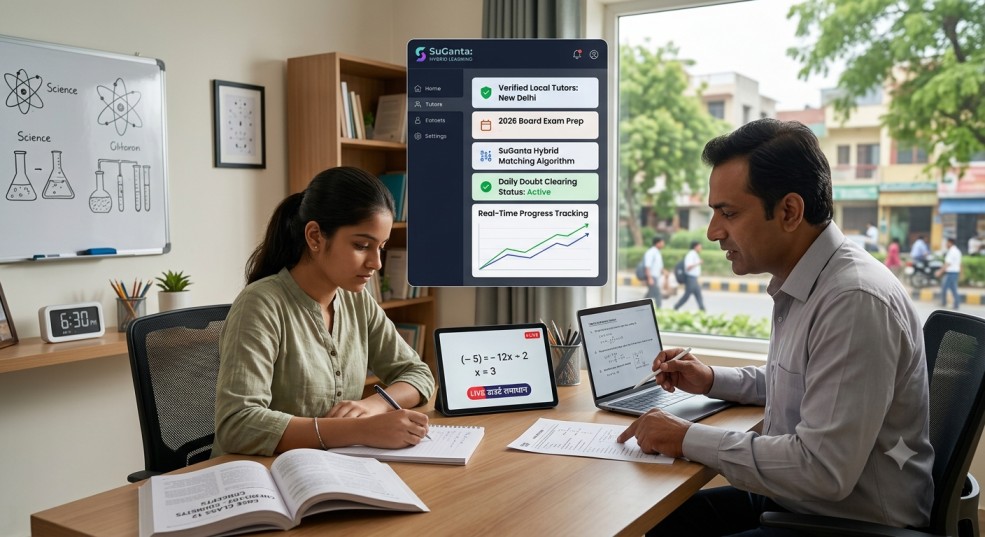
This is where Suganta Tutors fits perfectly into modern exam preparation. Suganta Tutors connects students with experienced and verified teachers for UPSC, JEE, and other competitive exams.
Students can use AI tools for quick revision, doubt-solving, and planning, while teachers on Suganta Tutors help with:
Personalized concept explanation
Exam-oriented strategy
Doubt-solving with real examples
Regular motivation and discipline
This combination of AI efficiency and human guidance creates a balanced preparation system that is ideal for 2026 aspirants.
Smart Way to Use AI Tools for UPSC and JEE
Students should use AI tools after studying from standard books and attending classes. AI should help in revision, clarification, and practice, not replace textbooks or teachers.
Consistency, discipline, and self-belief remain the most important factors for success.
FAQs: AI Tools for UPSC and JEE Preparation
Can AI tools help crack UPSC or JEE alone?
No. AI tools are support systems. Success depends on consistent study, guidance, and practice.
Which AI tool is best for UPSC?
ChatGPT, Gemini, and Grammarly are very useful when combined with standard books and teacher support.
Which AI tool is best for JEE?
ChatGPT and Photomath-type tools are helpful for concept clarity and problem-solving practice.
Are paid AI tools necessary?
No. Paid tools are optional. Many students succeed using free tools effectively.
How does Suganta Tutors help students preparing for competitive exams?
Suganta Tutors connects students with expert teachers who provide personalized guidance, exam strategies, and continuous support.
Final Thoughts
The future of exam preparation is a mix of technology and human guidance. AI tools will continue to grow smarter, but the importance of experienced teachers will never disappear.
For UPSC and JEE aspirants aiming for 2026, the smartest approach is to use AI tools wisely while learning from real mentors through platforms like Suganta Tutors. This balanced strategy saves time, improves understanding, and keeps preparation on the right track.
Remember, AI can guide you, teachers can shape you, but your dedication will decide your success.