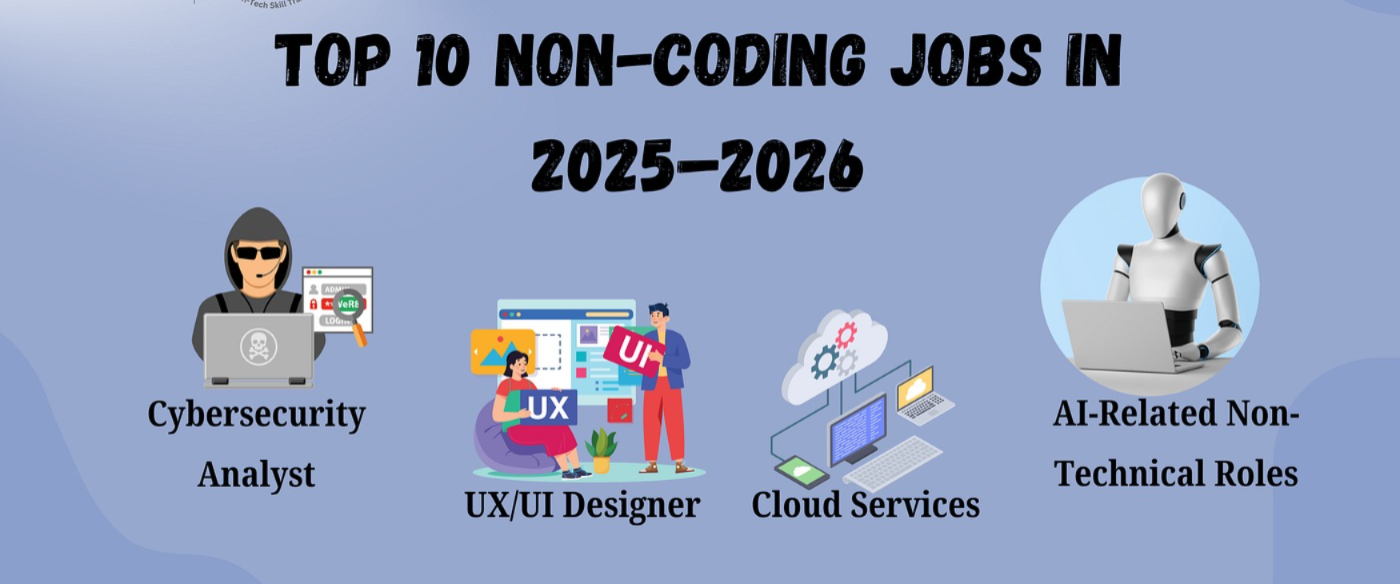
For many years, the word “IT career” in India was almost always linked with coding, programming languages, and long hours of writing software code. Students believed that if they were not good at coding, there was no future for them in technology. However, by 2026, this belief no longer holds true. The Indian IT industry has evolved, and today it offers a wide range of high-paying, stable, and respected non-coding career options.
Modern technology companies do not survive on coding alone. They need people who can understand users, manage teams, analyze data, ensure product quality, communicate with clients, write clear documentation, and guide business decisions. This shift has created strong demand for non-coding IT professionals, making it possible for students from arts, commerce, management, and even pure science backgrounds to enter the tech industry confidently.
This blog is written for students, fresh graduates, and working professionals who want to build a future in IT without getting stuck in complex programming. You will understand which non-coding IT jobs are best in India for 2026, how much salary you can realistically expect, which certifications actually help, and how Suganta Tutors connects perfectly with this journey by offering clear guidance and practical learning support.
The Rise of Non-Coding IT Careers in India
India’s IT sector is now focused on products, user experience, data-driven growth, automation, and global customers. Because of this, companies need professionals who can think strategically, communicate clearly, and understand technology at a functional level. While developers build the product, non-coding professionals decide what should be built, how it should work, how it should be tested, how users interact with it, and how it reaches the market.
Automation and artificial intelligence have also changed the landscape. Routine coding tasks are increasingly automated, but roles that require human judgment, creativity, and decision-making are becoming more valuable. This is why non-coding roles are not only growing, but also becoming more secure and better paid.
Another reason for this growth is accessibility. Not every student enjoys coding, and not everyone learns the same way. Non-coding IT jobs allow talented individuals to enter the tech industry using their strengths, whether that is communication, analysis, design, management, or problem-solving.
Understanding What Non-Coding IT Jobs Really Are
Non-coding IT jobs are technology-focused roles where deep programming knowledge is not required on a daily basis. These professionals work closely with technical teams, digital tools, and software products, but their main responsibility is not writing code. Instead, they focus on planning, testing, analysis, coordination, design, documentation, or business growth.
This does not mean that technical understanding is unnecessary. On the contrary, non-coding professionals must understand how technology works at a conceptual level so they can communicate effectively with developers and stakeholders. The difference is that they do not need to master complex algorithms or programming languages.
Product Manager: The Brain Behind Tech Products
One of the most respected non-coding IT roles in 2026 is Product Manager. A Product Manager decides what features a product should have, what problems it should solve, and how it should evolve over time. This role requires deep thinking, user understanding, and strong communication skills.
Product Managers work closely with designers, developers, marketers, and business leaders. They analyze user needs, market trends, and business goals, then convert them into clear product plans. In India, the demand for skilled Product Managers is increasing rapidly, especially in startups and SaaS companies.
In terms of salary, Product Managers are among the highest-paid non-coding professionals. Entry-level roles usually start around eight to twelve lakh per year, while experienced professionals earn between fifteen to twenty-five lakh. Senior Product Managers and Product Heads can earn even more.
Suganta Tutors supports aspiring Product Managers by offering simplified notes on product frameworks, agile methodologies, and real-world case studies. Instead of overwhelming learners with theory, Suganta Tutors focuses on practical understanding, which is exactly what companies look for during interviews.
Data Analyst: Turning Numbers Into Decisions
Data Analysts play a crucial role in modern IT companies. Every digital product generates massive amounts of data, but data alone has no value unless someone can interpret it. This is where Data Analysts come in.
A Data Analyst studies data to understand patterns, trends, and problems. They help companies make informed decisions related to marketing, sales, customer behavior, and product performance. While some basic technical tools like Excel, SQL, and dashboards are used, heavy coding is not required.
In India, Data Analysts earn respectable salaries, with freshers earning around four to seven lakh per year. With experience and strong skills, this can grow to fifteen lakh or more. This role is especially suitable for students who enjoy numbers, logic, and problem-solving.
Suganta Tutors helps learners build a strong foundation in data analysis through clear explanations, real datasets, and guided practice. The focus is always on understanding concepts rather than memorizing tools.
UX/UI Designer: Where Creativity Meets Technology
UX and UI Designers focus on how users interact with digital products. Their job is to make websites and applications simple, attractive, and easy to use. This role is ideal for people who are creative but also logical.
UX Designers research user behavior, create wireframes, and test designs, while UI Designers focus more on visual elements like colors, layouts, and typography. Coding knowledge is not mandatory, but understanding how digital products work is important.
In 2026, UX/UI Designers in India earn competitive salaries, starting from five to eight lakh for beginners and going up to twenty-five lakh or more for experienced professionals.
Suganta Tutors supports this career path by helping students understand design thinking, user psychology, and portfolio creation in a simple and structured way.
Manual QA Tester: The Quality Guardian of Software
Quality Assurance testers ensure that software products work correctly before they reach users. Manual QA testers focus on finding bugs, testing features, and ensuring smooth user experience without writing code.
This role is perfect for individuals who are detail-oriented and patient. It is also one of the easiest entry points into the IT industry for non-technical backgrounds.
Salaries for QA testers start around three to five lakh per year and grow steadily with experience. Certifications like ISTQB add credibility and improve job prospects.
Suganta Tutors offers exam-oriented notes and real testing examples that help learners understand testing concepts practically.
IT Project Manager: Managing Tech Without Coding
Project Managers are responsible for planning, executing, and delivering IT projects on time. They manage teams, schedules, budgets, and risks. Their role is more about leadership and organization than technical execution.
Experienced IT Project Managers in India earn between ten to thirty-five lakh per year, depending on their experience and certifications like PMP or Scrum Master.
Suganta Tutors helps learners understand project management concepts in an easy way, focusing on real-world scenarios instead of textbook definitions.
Business Analyst: The Translator Between Business and Tech
Business Analysts understand business problems and translate them into technical requirements. They act as a bridge between clients and technical teams.
This role requires strong communication, analytical thinking, and documentation skills. Coding is not required, but clarity of thought is essential.
Business Analysts in India earn between five to twenty lakh per year depending on experience. Suganta Tutors provides practical templates and examples that help learners grasp this role effectively.
Technical Writer, Recruiter, Pre-Sales Consultant, and Digital Marketer
Other strong non-coding IT careers include Technical Writing, where professionals create product documentation; Technical Recruitment, where hiring and screening tech talent is the focus; Pre-Sales Consulting, which involves product demos and client interaction; and Digital Marketing, where SEO, analytics, and online growth strategies are used.
Each of these roles offers good salary growth and long-term stability when supported by the right skills and certifications. Suganta Tutors connects learning with real industry expectations in all these areas.
Why Suganta Tutors Is the Right Partner for Non-Coding IT Careers
Suganta Tutors understands that learners do not want unnecessary complexity. They want clarity, direction, and confidence. That is why Suganta Tutors focuses on easy language, concept clarity, and career-oriented preparation.
Instead of teaching everything, Suganta Tutors teaches what actually matters for jobs and certifications. This approach saves time, reduces confusion, and builds confidence.
Frequently Asked Questions
Many students worry whether non-coding IT jobs are safe in the future. The answer is yes, because these roles depend on human judgment, creativity, and communication. Others ask whether non-technical students can enter IT, and the answer is absolutely yes with proper guidance. Certifications are not compulsory but they significantly improve credibility. Career switches usually take three to six months with focused learning.
Final Thoughts
You do not need to be a programmer to succeed in IT in 2026. Non-coding IT jobs are real, respected, and rewarding. With the right mindset, certifications, and guidance from platforms like Suganta Tutors, you can build a strong and future-ready career in technology.




