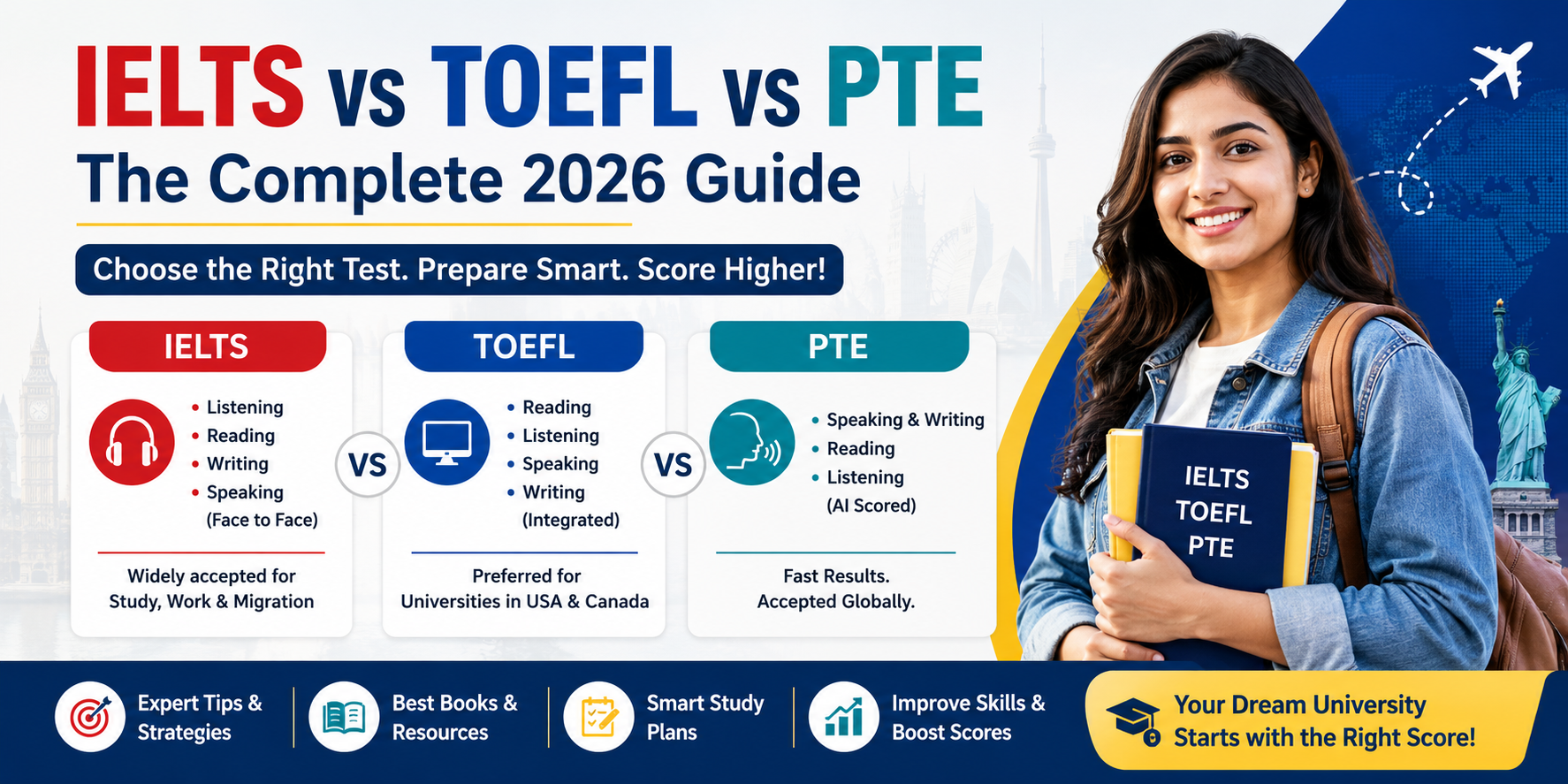
IELTS, TOEFL, or PTE: Your First Step Toward Studying Abroad
Dreaming of studying in Canada, Australia, the UK, the USA, New Zealand, or Europe?
Before universities evaluate your academic achievements, they need proof that you can communicate effectively in English. That's where English proficiency tests such as IELTS, TOEFL, and PTE come into the picture.
Every year, millions of students take these exams to secure admission to international universities, obtain student visas, and improve their career opportunities abroad.
The challenge isn't just passing the exam.
The real challenge is achieving the score your dream university requires.
Many students spend months studying but fail to reach their target because they follow outdated preparation methods, focus on the wrong resources, or practice without a proper strategy.
This guide will help you:
✅ Understand the difference between IELTS, TOEFL, and PTE
✅ Choose the right exam based on your goals
✅ Learn proven preparation strategies
✅ Improve listening, reading, writing, and speaking skills
✅ Discover free and paid preparation resources
✅ Create a practical study plan that works in 2026
Why English Proficiency Tests Matter More Than Ever in 2026
International education is becoming increasingly competitive.
Universities now receive applications from students worldwide, making language proficiency a critical factor in admissions decisions.
A strong English score can:
- Increase admission chances
- Improve scholarship opportunities
- Strengthen visa applications
- Enhance classroom performance
- Build confidence in professional environments
Even if English was your medium of education, most universities still require an approved English language test.
Understanding IELTS, TOEFL, and PTE
Many students ask:
"Which exam is easier?"
The truth is that no exam is universally easier. The best choice depends on your strengths, learning style, and university requirements.
IELTS (International English Language Testing System)
IELTS remains one of the world's most trusted English proficiency exams.
It is accepted by thousands of universities, employers, and immigration authorities globally.
Best For:
- Canada immigration
- UK universities
- Australia universities
- New Zealand applications
- Students who prefer interacting with real people
Exam Structure
| Section | Duration |
|---|---|
| Listening | 30 Minutes |
| Reading | 60 Minutes |
| Writing | 60 Minutes |
| Speaking | 11–14 Minutes |
One major advantage of IELTS is its face-to-face speaking test with a certified examiner.
Students who communicate confidently in conversations often perform well here.
TOEFL iBT
TOEFL focuses heavily on academic English and is especially popular in North America.
Best For:
- USA universities
- Academic research programs
- Students comfortable using computers
Unlike IELTS, TOEFL speaking responses are recorded and assessed later.
Some students prefer this because it removes the pressure of speaking directly to an examiner.
PTE Academic
PTE has become one of the fastest-growing English tests worldwide.
The exam uses AI-powered scoring technology and offers rapid results.
Best For:
- Australia student visas
- Australia PR pathways
- Students seeking faster results
- Candidates comfortable with technology
Many students receive results within 48 hours, making it attractive for urgent university deadlines.
IELTS vs TOEFL vs PTE: Quick Comparison
| Feature | IELTS | TOEFL | PTE |
|---|---|---|---|
| Speaking | Human Examiner | Recorded | AI-Assessed |
| Result Time | 3–13 Days | 4–8 Days | 24–48 Hours |
| Accepted Worldwide | Yes | Yes | Increasingly |
| Test Format | Paper/Computer | Computer | Computer |
| Immigration Acceptance | Excellent | Good | Excellent |
How to Choose the Right Exam
Choose IELTS if:
✔ You speak confidently in person
✔ You're applying to the UK, Canada, or Australia
✔ You prefer interacting with humans
Choose TOEFL if:
✔ You're targeting American universities
✔ You're comfortable with academic English
✔ You prefer computer-based testing
Choose PTE if:
✔ You need quick results
✔ You're applying to Australia
✔ You're comfortable speaking into a microphone
Proven Strategies to Improve Your Listening Score
Listening is one of the easiest sections to improve when approached correctly.
Most students simply listen.
Top scorers actively analyze what they hear.
Daily Listening Routine
Morning:
- Listen to BBC World Service for 15 minutes
Afternoon:
- Watch a TED Talk
Evening:
- Complete one listening practice exercise
Best Listening Resources
- BBC Learning English
- TED Talks
- IELTS Advantage
- E2 Language
- British Council Learning Hub
Common Listening Mistakes
❌ Losing focus after missing one answer
❌ Ignoring spelling
❌ Not predicting answers
❌ Failing to understand different accents
Reading Strategies That Actually Work
Reading isn't about understanding every word.
It's about finding information quickly.
Successful candidates use:
Skimming
Reading quickly to understand the main idea.
Scanning
Searching for specific information.
Keyword Matching
Identifying alternative words and synonyms.
For example:
Question: "Increase"
Passage: "Growth"
Many students miss correct answers because they look for exact words.
How to Improve Your Writing Score
Writing is often the lowest-scoring section because students focus too much on grammar and not enough on structure.
Examiners want:
- Clear organization
- Strong ideas
- Accurate vocabulary
- Logical progression
A simple structure often scores higher than a complicated essay filled with mistakes.
Speaking Confidence: The Secret Behind High Scores
One of the biggest misconceptions is:
"I need perfect English to get a high score."
Not true.
Examiners evaluate:
- Fluency
- Pronunciation
- Vocabulary
- Grammar
- Communication ability
Many Band 7 and Band 8 candidates make occasional mistakes.
The difference is that they continue speaking confidently.
Daily Speaking Practice
- Describe your day in English
- Record yourself for 2 minutes
- Answer common IELTS questions
- Speak with tutors or language partners
Even 20 minutes daily can transform your speaking ability within a few weeks.
Why Professional Coaching Can Save Months of Preparation
Self-study works.
But expert guidance often speeds up progress significantly.
Experienced trainers help students:
- Avoid common mistakes
- Understand examiner expectations
- Receive speaking feedback
- Improve essay structure
- Build personalized study plans
The most successful candidates typically combine:
70% self-study + 30% expert guidance
This balance provides flexibility while ensuring steady improvement.
Best Books for IELTS, TOEFL & PTE in 2026
IELTS
- The Official Cambridge Guide to IELTS
- IELTS Trainer 2
- Barron's IELTS Superpack
- Cambridge IELTS Practice Series
TOEFL
- Official TOEFL iBT Guide
- Kaplan TOEFL Prep
- Barron's TOEFL iBT
PTE
- Official Guide to PTE Academic
- Expert PTE Academic
- Pearson Practice Test Series
60-Day Study Plan for Busy Students
Days 1–15
- Understand exam format
- Identify weaknesses
- Build vocabulary
Days 16–30
- Focus on Reading and Listening
Days 31–45
- Intensive Speaking and Writing practice
Days 46–55
- Full-length mock tests
Days 56–60
- Revision
- Error analysis
- Confidence building
Final Thoughts
Choosing between IELTS, TOEFL, and PTE isn't about finding the easiest exam—it's about finding the exam that best matches your strengths and future goals.
The students who achieve top scores aren't necessarily the smartest.
They're the ones who follow a structured study plan, practice consistently, take regular mock tests, and learn from their mistakes.
Whether your dream is to study in Canada, pursue a master's degree in the USA, migrate to Australia, or unlock international career opportunities, your English proficiency score can be the key that opens those doors.
Start today, stay consistent, and remember that every practice session brings you one step closer to your study-abroad journey.
FAQ Schema Section (20 Questions)
1. Which is easier: IELTS, TOEFL, or PTE?
The answer depends on your strengths. IELTS suits candidates comfortable with face-to-face speaking, while PTE benefits those comfortable with computer-based testing.
2. Which English test is accepted worldwide?
IELTS and TOEFL are accepted by most universities globally, while PTE acceptance continues to grow rapidly.
3. How long should I prepare for IELTS?
Most candidates require 6–12 weeks of focused preparation.
4. Is PTE easier than IELTS?
Not necessarily. PTE uses AI scoring and requires strong computer-based test skills.
5. What is a good IELTS score?
A band score of 6.5–7.5 is considered competitive for many universities.
6. What is a good TOEFL score?
A score above 90 is generally considered strong.
7. What is a good PTE score?
Most universities require between 58 and 79.
8. Can I prepare without coaching?
Yes, but coaching can accelerate improvement and provide personalized feedback.
9. Which test gives results fastest?
PTE typically provides results within 24–48 hours.
10. Is IELTS speaking face-to-face?
Yes, IELTS speaking is conducted with a human examiner.
11. How many times can I take IELTS?
There is no limit on attempts.
12. Are IELTS and TOEFL valid for immigration?
Yes, depending on the country and immigration program.
13. Which exam is best for Australia?
IELTS and PTE are widely accepted across Australia.
14. How can I improve listening skills?
Practice daily with podcasts, news broadcasts, and official mock tests.
15. Which books are best for IELTS in 2026?
The Official Cambridge Guide to IELTS and IELTS Trainer 2 remain top choices.
16. How much does IELTS cost?
Fees vary by country and testing center.
17. Can I prepare in one month?
Yes, if you already possess intermediate English proficiency.
18. Which exam is best for the USA?
TOEFL remains highly preferred by many U.S. universities.
19. Does PTE have a human examiner?
No, PTE speaking is scored by AI technology.
20. How often should I take mock tests?
At least one full-length mock test every week during preparation.




