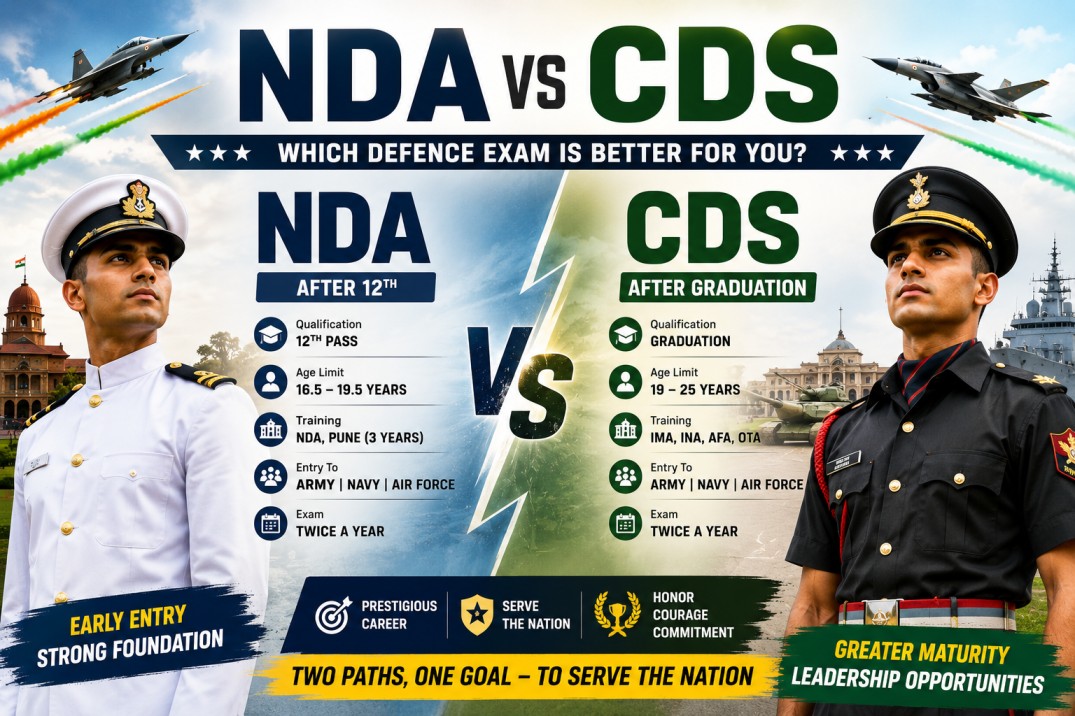
Every year, lakhs of young Indians dream of wearing the uniform of the Indian Armed Forces and serving the nation with pride. For many students, this dream begins with a single question: “Should I prepare for NDA or CDS?”At first glance, both examinations appear similar because they ultimately lead to the same destination—a prestigious officer rank in the Indian Army, Indian Navy, or Indian Air Force. However, when we look deeper, NDA and CDS are entirely different journeys. They differ in eligibility, age requirements, educational qualifications, training structure, lifestyle, competition level, and even the way an officer develops during military training.Understanding these differences is extremely important because the decision you make today can influence your entire defence career for decades.
The Foundation of a Military Career
The National Defence Academy is often considered the most prestigious military entry route in India. NDA provides students an opportunity to begin military training immediately after completing Class 12. At an age when most students are deciding which college to join, NDA aspirants start preparing themselves to become future military leaders.
The Combined Defence Services Examination, on the other hand, is designed for graduates. Candidates complete their higher education first and then enter military training through institutions such as the Indian Military Academy, Air Force Academy, Indian Naval Academy, or Officers Training Academy.
Both paths are respected, but they create officers in very different ways.
The Difference Between Starting at 17 and Starting at 23
One of the biggest differences between NDA and CDS is age.
An NDA candidate typically joins military training between the ages of 16.5 and 19.5 years. At this stage, the armed forces shape the candidate's personality from a very young age. Leadership, discipline, confidence, responsibility, physical fitness, and military values become part of everyday life.
A CDS candidate usually joins training after graduation, often between the ages of 21 and 25. These candidates arrive with greater academic maturity, broader life experiences, and a college education. Instead of building basic personality traits, military academies focus on rapidly transforming them into officer material.
This difference in age creates two distinct training philosophies. NDA develops future officers over a longer period, while CDS prepares already mature candidates for leadership responsibilities within a shorter timeframe.
Life at NDA: More Than Just Military Training
Life at the National Defence Academy is unlike any college experience in India.
Imagine waking up before sunrise every morning. Physical training begins early. Cadets spend their days balancing academics, military drills, sports, leadership exercises, obstacle courses, outdoor camps, and character-building activities.
Every moment at NDA is designed to build discipline and resilience.
Unlike ordinary educational institutions, NDA focuses equally on mental strength, physical fitness, and leadership development. Cadets learn how to lead teams under pressure, make decisions in challenging situations, and remain calm during adversity.
The friendships formed during NDA training often last a lifetime because cadets experience challenges, hardships, victories, and personal growth together.
Many senior military leaders believe that NDA's greatest strength is not its academics or military training—it is the environment that transforms teenagers into leaders.
Life After CDS Selection
Life through the CDS route is equally prestigious but different in nature.
Since candidates have already completed graduation, training focuses more directly on military leadership and operational responsibilities.
The pace is faster. Expectations are higher.
In NDA, cadets have years to adapt to military life. In CDS academies, candidates are expected to adjust quickly because they are older and more mature.
Training emphasizes tactical thinking, leadership under pressure, weapon handling, military operations, and officer responsibilities.
Many CDS officers bring valuable experiences from engineering, science, commerce, humanities, and other academic backgrounds, which often help them during military service.
Syllabus Comparison: NDA vs CDS
Students often assume that CDS is simply an advanced version of NDA. This is not entirely true.
The NDA syllabus focuses heavily on Class 11 and Class 12 concepts. Mathematics plays a major role and requires strong problem-solving skills. The General Ability Test covers English, Physics, Chemistry, Biology, History, Geography, and Current Affairs.
CDS follows a different approach.
The examination is designed for graduates and emphasizes English proficiency, General Knowledge, Current Affairs, and Elementary Mathematics. Although the Mathematics syllabus may appear smaller than NDA, competition among graduates makes the examination equally challenging.
The biggest difference is not necessarily syllabus difficulty but the level of competition. NDA candidates compete against school students, while CDS candidates compete against graduates from across India.
Physical Fitness and Medical Standards
Whether you choose NDA or CDS, physical fitness is non-negotiable.
The armed forces demand high medical and physical standards because officers must lead troops under demanding conditions.
Candidates must maintain healthy body weight, good eyesight, strong endurance, and overall physical fitness.
Those preparing for either examination should begin physical training early. Running, strength training, flexibility exercises, and stamina-building activities should become part of daily life.
Physical preparation not only helps during selection but also makes military training significantly easier.
Career Growth: Does NDA Offer Faster Promotions?
One of the most common myths among defence aspirants is that NDA officers receive faster promotions than CDS officers.
This is false.
Once commissioned, all officers enter the same promotion structure. Career progression depends on performance, leadership abilities, service record, professional qualifications, and organizational requirements.
An exceptional CDS officer can rise faster than an average NDA officer.
Similarly, an outstanding NDA officer can achieve remarkable success throughout his or her career.
The armed forces reward merit, professionalism, and leadership—not the examination through which an officer entered service.
Salary and Financial Benefits
Another area where students frequently compare NDA and CDS is salary.
The reality is simple.
There is virtually no difference in salary based on entry route. Officers commissioned through NDA and CDS receive pay according to their rank and service branch.
Benefits typically include:
- Attractive Government Salary
- Military Service Pay
- Free Medical Facilities
- Government Accommodation
- Leave Travel Benefits
- Pension Benefits
- Insurance Coverage
- Educational Support
- Canteen Facilities
The real advantage lies not in salary differences but in the opportunity to serve the nation while building a respected and rewarding career.
Which Examination Is More Difficult?
This question has no simple answer.
NDA attracts a massive number of students every year. Competition is intense, particularly in Mathematics and General Ability.
CDS attracts graduates from engineering colleges, universities, and professional institutions across India. Although the number of applicants may be lower, the quality of competition is often extremely high.
Both examinations require dedication, discipline, and consistent preparation.
Instead of asking which examination is easier, students should ask which examination aligns better with their current educational stage.
The Final Decision: NDA or CDS?
If you are currently in Class 11 or Class 12 and are absolutely certain about serving in the armed forces, NDA is generally the superior choice. It offers earlier entry, longer military training, stronger leadership development, and a unique academy experience that shapes your personality from a young age.
If you are already pursuing graduation or have completed your degree, CDS is the ideal route. It provides a prestigious opportunity to enter the armed forces without missing the chance to obtain a university education.
Ultimately, NDA and CDS are not competing pathways. They are simply different roads leading to the same destination.
Both produce brave officers.
Both create military leaders.
Both offer honor, respect, adventure, and national service.
The best choice is the one that matches your age, qualifications, and long-term goals.
Whether you enter through NDA or CDS, success will depend on your discipline, commitment, leadership qualities, and determination to serve India with pride.
FAQs: NDA vs CDS Comparison
1. What is the difference between NDA and CDS?
NDA is for students after Class 12, while CDS is for graduates who wish to join the Indian Armed Forces as officers.
2. Which is better, NDA or CDS?
Both are prestigious defence entry routes. NDA is better for candidates who want to join after Class 12, while CDS is suitable for graduates.
3. What is the full form of NDA?
NDA stands for National Defence Academy.
4. What is the full form of CDS?
CDS stands for Combined Defence Services Examination.
5. Who conducts NDA and CDS exams?
Both examinations are conducted by the UPSC (Union Public Service Commission).
6. Can I apply for CDS after NDA?
Yes, if you meet the CDS eligibility criteria after graduation.
7. Can I apply for NDA after graduation?
No. NDA has an upper age limit and is intended for candidates after Class 12.
8. Which exam has a higher age limit?
CDS has a higher age limit than NDA.
9. Is NDA easier than CDS?
Both exams are competitive. NDA focuses on Class 12-level concepts, while CDS competition is among graduates.
10. Which exam has more applicants?
NDA generally attracts more applicants because students can apply immediately after Class 12.
11. Is Mathematics compulsory in NDA?
Yes, Mathematics is one of the main papers in the NDA examination.
12. Is Mathematics compulsory in CDS?
Mathematics is required for IMA, INA, and AFA entries but not for OTA.
13. Which exam is better for Army aspirants?
Both NDA and CDS lead to Army officer positions.
14. Which exam is better for Air Force aspirants?
Both pathways provide opportunities to join the Air Force depending on eligibility and selection.
15. Which exam is better for Navy aspirants?
Both NDA and CDS offer entry into the Indian Navy.
16. What qualification is required for NDA?
Candidates must have passed Class 12 from a recognized board.
17. What qualification is required for CDS?
Candidates must possess a bachelor's degree from a recognized university.
18. Does NDA have an SSB interview?
Yes, NDA candidates must clear the SSB interview after the written examination.
19. Does CDS have an SSB interview?
Yes, CDS candidates also undergo the SSB interview process.
20. Is the SSB process the same for NDA and CDS?
The assessment process is largely similar, though expectations may differ based on candidate maturity and educational background.
21. Which provides earlier entry into defence services?
NDA provides earlier entry because candidates join after Class 12.
22. Which route provides longer military training?
NDA provides longer training compared to CDS.
23. Is salary different for NDA and CDS officers?
No. Salary depends on rank and service, not on the entry route.
24. Do NDA officers get higher ranks than CDS officers?
No. Both can rise to the highest ranks based on performance and service record.
25. Can women apply for NDA?
Yes, eligible female candidates can apply for NDA.
26. Can women apply for CDS?
Yes, eligible female candidates can apply for CDS.
27. Which exam offers better career growth?
Both offer similar promotion and career growth opportunities.
28. Is coaching necessary for NDA?
Coaching is not mandatory but can significantly improve preparation and selection chances.
29. Is coaching necessary for CDS?
Coaching is optional but beneficial for structured preparation.
30. Which exam should I choose after Class 12?
If eligible, NDA is usually the preferred option after Class 12.
31. Which exam should I choose after graduation?
CDS is the most suitable defence officer entry route after graduation.
32. What is the biggest advantage of NDA?
Earlier entry into the armed forces and longer military training.
33. What is the biggest advantage of CDS?
Graduates get another opportunity to become officers even if they missed NDA.
34. Can NDA and CDS officers become Generals or Chiefs?
Yes. Officers from both entry routes can reach the highest leadership positions.
35. Which defence exam is best for long-term career growth?
Both NDA and CDS provide excellent long-term career growth, leadership opportunities, salary benefits, and the honor of serving the nation.
36. Can Arts students apply for NDA and CDS?
Arts students can apply for NDA Army Wing and CDS entries that meet the required educational qualifications.
37. Can Commerce students appear for NDA?
Yes, Commerce students can apply for NDA Army Wing.
38. Which exam has a tougher Mathematics section?
NDA Mathematics is broader and based on Class 11–12 concepts, while CDS Mathematics is generally at the matriculation level but remains competitive.
39. How many attempts are allowed for NDA?
Candidates can appear multiple times within the prescribed age limit.
40. How many attempts are allowed for CDS?
There is no fixed attempt limit; candidates can apply as long as they meet age and eligibility requirements.
41. Which exam is better for becoming a pilot?
Both NDA and CDS provide opportunities to join the Indian Air Force flying branch.
42. Is physical fitness important for NDA and CDS?
Yes. Physical fitness plays a crucial role in medical examinations and future military training.
43. Can I prepare for NDA and CDS simultaneously?
Since they target different educational levels, preparation strategies differ, but many subjects overlap.
44. Which exam has a better success rate?
Success depends more on preparation quality, consistency, and SSB performance than the examination itself.
45. Why is NDA considered prestigious?
NDA is one of the world's premier military academies and has produced many distinguished military leaders.
NDA vs CDS: Basic Difference
The biggest difference between NDA and CDS lies in the stage at which candidates enter the defence services.
NDA allows students to begin their defence journey immediately after Class 12, whereas CDS requires candidates to complete graduation before applying.
As a result, NDA candidates generally start their military careers earlier and receive longer military training. CDS candidates, on the other hand, enter with greater academic maturity and life experience gained during their college years.
Eligibility Criteria Comparison
One of the most important differences between NDA and CDS is educational qualification.
For NDA, candidates only need to pass Class 12 from a recognized board. Students from Science, Commerce, and Arts backgrounds can apply for the Army Wing. However, candidates applying for the Navy and Air Force Wings must have studied Physics and Mathematics in Class 12.
For CDS, candidates must possess a bachelor's degree from a recognized university. Specific academies may require Mathematics or Engineering-related qualifications.
Because CDS requires graduation, candidates generally enter military training three to four years later than NDA aspirants.
Age Limit Comparison
Age eligibility is another major distinction.
NDA candidates are typically between 16.5 and 19.5 years of age. This makes NDA suitable for students immediately after school education.
CDS candidates generally fall between 19 and 25 years of age, depending on the academy they choose. This wider age range provides an opportunity for graduates to pursue defence careers even after completing higher education.
Examination Pattern Comparison
The NDA written examination consists of two major papers: Mathematics and General Ability Test.
The Mathematics section carries 300 marks and focuses on Class 11 and Class 12 concepts. The General Ability Test carries 600 marks and evaluates English proficiency, General Knowledge, Science, History, Geography, and Current Affairs.
The CDS examination follows a different structure. Candidates for IMA, INA, and AFA must appear for English, General Knowledge, and Elementary Mathematics papers. Candidates applying for OTA only need to appear for English and General Knowledge.
Although CDS has fewer papers, the level of competition remains extremely high because candidates are graduates and often have more academic experience.
Difficulty Level: NDA vs CDS
A common question among defence aspirants is which examination is more difficult.
NDA is highly competitive because lakhs of Class 12 students apply every year. The Mathematics section is particularly challenging and requires strong conceptual understanding and speed.
CDS competition is different because candidates are graduates competing against older and more mature aspirants. The examination may appear simpler on paper, but the quality of competition is often higher.
Rather than comparing difficulty, students should focus on selecting the examination that aligns with their educational stage.
Training Comparison
Training is where NDA and CDS differ significantly.
NDA cadets spend approximately three years undergoing military and academic training before proceeding to specialized service academies. This longer training duration allows for comprehensive personality development and military preparation.
CDS candidates join military academies after graduation and undergo shorter but intensive officer training programs. Their training is designed to prepare them quickly for leadership roles within the armed forces.
NDA graduates often benefit from a stronger military foundation due to their extended training period.
Career Growth Opportunities
Many candidates wonder whether NDA officers receive better promotions than CDS officers.
The answer is no.
Once commissioned, both NDA and CDS officers receive the same rank structure, promotion opportunities, salary benefits, and career progression pathways. Promotions are based on performance, service record, leadership qualities, and organizational requirements rather than the entry route.
Whether an officer enters through NDA or CDS, they can rise to the highest positions within the Indian Armed Forces.
Salary Comparison
Another popular misconception is that NDA officers receive higher salaries than CDS officers.
In reality, both NDA and CDS officers receive the same pay structure after commissioning. Salary depends on rank, experience, allowances, and service branch rather than the examination through which the officer entered.
Both receive:
Military Service Pay
Government Accommodation
Medical Facilities
Travel Benefits
Pension Benefits
Insurance Coverage
Educational Benefits
Therefore, salary should not be a deciding factor when choosing between NDA and CDS.
NDA vs CDS for Army Aspirants
Students who dream of joining the Indian Army should ideally choose NDA if they are eligible after Class 12. NDA provides earlier exposure to military culture and leadership training.
However, CDS remains an excellent option for graduates who develop an interest in defence services later in life.
Both routes ultimately lead to officer positions within the Army.
NDA vs CDS for Air Force Aspirants
Candidates interested in becoming Air Force officers can pursue either NDA or CDS depending on their age and educational qualifications.
NDA allows earlier entry into the Air Force, while CDS provides opportunities after graduation. Both pathways can eventually lead to flying and technical branches depending on eligibility and selection.
NDA vs CDS for Navy Aspirants
Similarly, Navy aspirants can enter through either NDA or CDS. NDA provides extensive military foundation training, whereas CDS offers a graduate-level entry route into naval leadership roles.
Which Exam Should You Choose?
If you are currently studying in Class 11 or Class 12 and are certain about a defence career, NDA is generally the better choice. It allows earlier entry, longer training, and a stronger military foundation.
If you have already completed graduation or wish to keep multiple career options open during college, CDS is the ideal pathway.
The best choice is not determined by which examination is easier or more prestigious but by which examination matches your current stage of education and career goals.
Final Verdict
NDA and CDS are both prestigious pathways to becoming an officer in the Indian Armed Forces. NDA is best suited for students who are committed to a defence career immediately after school, while CDS provides a valuable opportunity for graduates who decide to join the military later.
Both routes offer excellent salaries, leadership opportunities, professional growth, and the honor of serving the nation. Ultimately, success depends not on whether you choose NDA or CDS, but on your dedication, preparation, and determination to become a future military leader.
For most students eligible for both routes, NDA remains the preferred option because of its earlier entry and comprehensive military training. However, CDS continues to be one of the most respected and competitive defence examinations in India and has produced countless distinguished officers.




