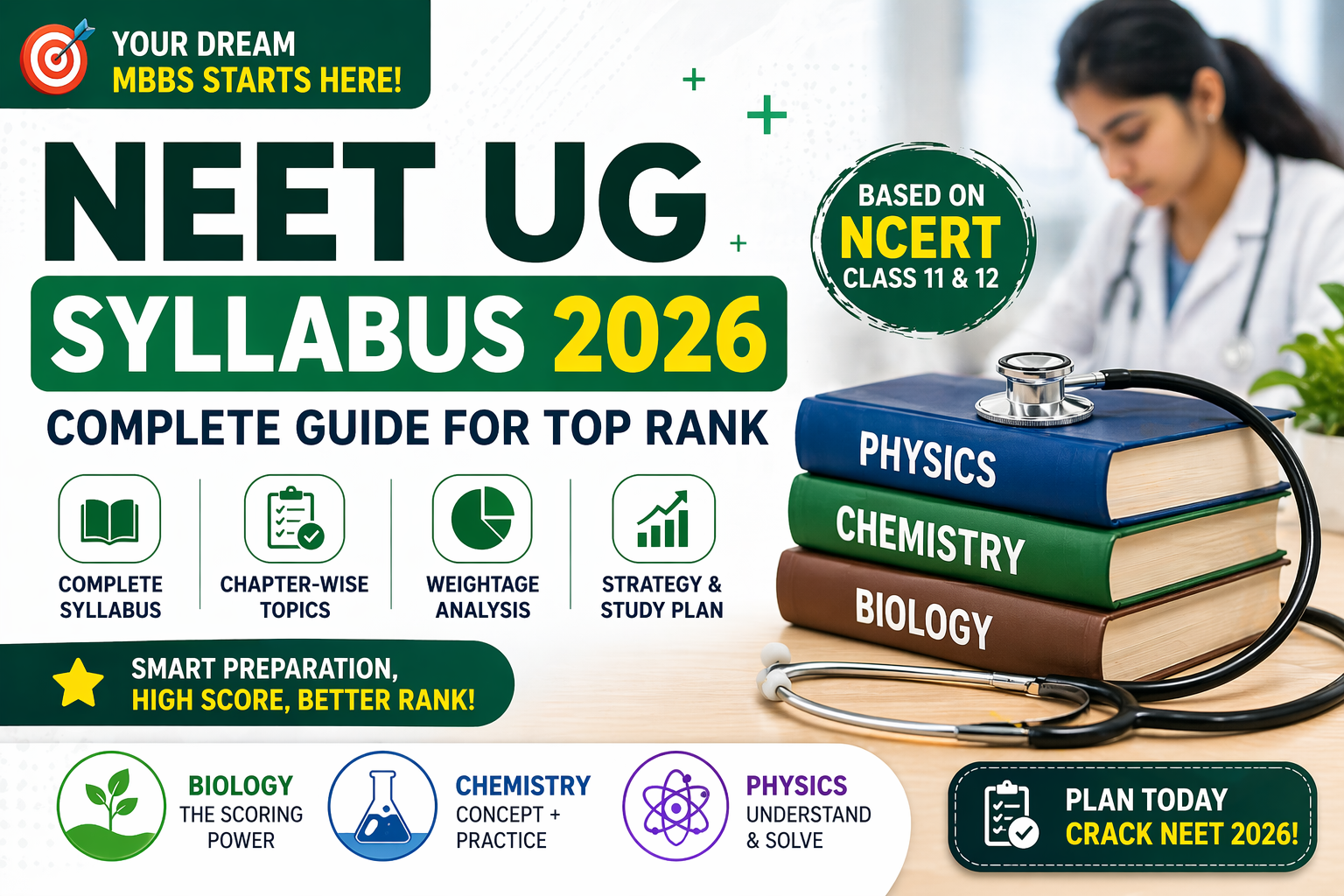
This guide covers everything you need:
- Complete NEET UG syllabus 2026 (Physics, Chemistry, Biology)
- Chapter-wise important topics
- High-weightage chapters
- Best preparation strategy
- Study plan for NEET 2026
If you’re searching for “complete NEET syllabus 2026” or “how to prepare for NEET from zero level”, this article is your roadmap.
📚 NEET UG 2026 Syllabus Overview
The NEET syllabus 2026 is based on NCERT Class 11 and 12. The exam includes three subjects:
- Physics
- Chemistry
- Biology (Botany + Zoology)
👉 Biology carries the highest weightage, making it the most scoring subject in NEET.
🌿 Biology Syllabus (Most Important Section)
Biology plays a crucial role in NEET. Around 50% of the paper comes from Biology alone.
🌱 Class 11 Biology Topics:
- Diversity of Living Organisms
- Structural Organisation in Animals and Plants
- Cell Structure and Function
- Plant Physiology
- Human Physiology
🧬 Class 12 Biology Topics:
- Reproduction
- Genetics and Evolution
- Biology and Human Welfare
- Biotechnology
- Ecology and Environment
👉 High-Weightage Biology Chapters for NEET:
- Human Physiology
- Genetics & Evolution
- Ecology
- Biotechnology
👉 Preparation Tip:
NCERT is your Bible. Read every line carefully and revise multiple times.
⚗️ Chemistry Syllabus (Scoring Section)
Chemistry in NEET is balanced between conceptual + memory-based questions.
🧪 Physical Chemistry:
- Mole Concept
- Thermodynamics
- Equilibrium
- Chemical Kinetics
🧬 Organic Chemistry:
- General Organic Chemistry
- Hydrocarbons
- Alcohols, Phenols, Ethers
- Biomolecules
🧱 Inorganic Chemistry:
- Periodic Table
- Chemical Bonding
- Coordination Compounds
- d & f Block
👉 High-Weightage Chemistry Topics:
- Organic Chemistry
- Coordination Compounds
- Chemical Bonding
👉 Preparation Tip:
Revise NCERT and practice reaction-based questions regularly.
🔬 Physics Syllabus (Conceptual Section)
Physics is often the toughest subject for NEET aspirants, but with practice, it becomes scoring.
📘 Class 11 Physics:
- Units and Measurements
- Kinematics
- Laws of Motion
- Work, Energy, Power
- Thermodynamics
- Oscillations
📘 Class 12 Physics:
- Electrostatics
- Current Electricity
- Magnetism
- Optics
- Modern Physics
👉 High-Weightage Physics Chapters:
- Modern Physics
- Current Electricity
- Thermodynamics
👉 Preparation Tip:
Practice numericals daily and revise formulas regularly.
📊 Chapter-wise Weightage (Important for Ranking)
Biology:
- Human Physiology – 20%
- Genetics – 18%
- Ecology – 10%
Chemistry:
- Organic – 35%
- Physical – 30%
- Inorganic – 35%
Physics:
- Modern Physics – 12%
- Electricity & Magnetism – 15%
🎯 Best NEET Preparation Strategy 2026
Cracking NEET requires consistency + smart planning.
📌 Step-by-Step Strategy:
- Start with NCERT basics
- Build strong concepts
- Solve previous year questions
- Take mock tests regularly
- Analyze mistakes and improve
🕒 Daily Study Plan:
- Biology – 3 hours
- Chemistry – 2 hours
- Physics – 2 hours
- Revision – 1 hour
📚 Best Books for NEET:
- NCERT (mandatory)
- HC Verma (Physics)
- OP Tandon (Chemistry)
- MTG NCERT at Your Fingertips (Biology)
🚀 High-Scoring Chapters (Rank Booster)
Biology:
- Human Physiology
- Genetics
- Ecology
Chemistry:
- Coordination Compounds
- Organic Reactions
Physics:
- Modern Physics
- Units & Dimensions
This will help you understand the syllabus in a more practical and strategic way.
❓ FAQs (High Ranking Section)
Q1: What is the complete NEET UG syllabus 2026?
The NEET UG syllabus 2026 includes Physics, Chemistry, and Biology from NCERT Class 11 and 12.
Q2: Is NCERT enough for NEET 2026?
Yes, NCERT is enough for Biology and very important for Chemistry, but Physics requires additional practice.
Q3: How to prepare for NEET from zero level?
Start with NCERT basics, build concepts, solve easy questions first, and gradually move to advanced level.
Q4: Which subject is most important for NEET?
Biology is the most important subject as it carries the highest weightage.
Q5: How many hours should I study for NEET?
You should study at least 6–8 hours daily with consistency.