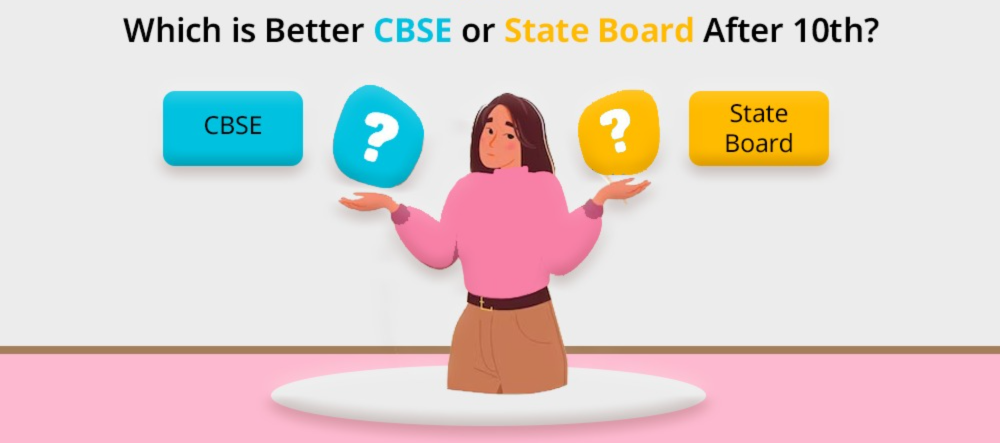
Choosing the right education board is one of the most important decisions for students and parents in India. When a child reaches school age, families often wonder which board will provide the best learning environment and future opportunities. Two of the most common options available are the State Board and the CBSE (Central Board of Secondary Education) board. Both education systems are widely followed across the country and have helped millions of students build successful careers. However, there are clear differences between them in terms of curriculum, teaching methods, exam patterns, and career opportunities.
Many parents believe that studying in the CBSE board gives students an advantage in national-level exams and career growth. On the other hand, some families prefer the State Board because they believe it is easier to understand and more connected to local culture and language. The truth is that both boards have their strengths and limitations. The real question is which board aligns better with a student’s career goals, learning style, and long-term academic plans.
Students today also rely on additional academic support such as CBSE board classes, guidance from educated teachers, and practice using previous year board question papers to prepare for exams effectively. Platforms like Suganta Tutors have made it easier for students to access expert guidance and personalized learning support, whether they are studying in CBSE or State Board schools.
In this detailed guide, we will explore the differences between State Board and CBSE, understand how each system impacts career opportunities, and explain how students can succeed regardless of the board they choose.
Understanding the Indian Education Board System
India has a diverse education system with multiple boards that design and regulate school curriculums. The most commonly recognized boards include State Boards, CBSE, and ICSE. Among these, the comparison between State Board and CBSE is the most common because they represent two different approaches to education.
State Boards are governed by the respective state governments. Each state has its own education board responsible for designing the syllabus, textbooks, and exam patterns for schools within that state. For example, Uttar Pradesh has the UP Board, Maharashtra has the Maharashtra State Board, and Tamil Nadu has the Tamil Nadu State Board. These boards develop their own curriculum based on regional educational priorities.
The CBSE board, on the other hand, is a national-level board governed by the central government. Schools affiliated with CBSE follow a uniform syllabus across India. This means that a student studying in a CBSE school in Delhi will learn the same topics as a student studying in a CBSE school in Mumbai or Bangalore.
This difference in governance and curriculum structure is the foundation of many differences between State Board and CBSE education systems.
What is the CBSE Board?
The Central Board of Secondary Education is one of the most widely recognized school boards in India. Thousands of schools across the country are affiliated with CBSE, including many international schools outside India.
CBSE is known for its focus on conceptual learning and structured academic development. The curriculum is designed to help students understand concepts deeply rather than simply memorizing information. Subjects like Mathematics and Science are given special importance because they are essential for many professional careers.
One of the key reasons CBSE is popular is that its syllabus aligns closely with national competitive exams such as JEE, NEET, and CUET. These exams are important for students who want to pursue careers in engineering, medicine, and other professional fields. Because the CBSE curriculum covers many of the topics required for these exams, students often find it easier to prepare for competitive tests.
Students studying in CBSE schools frequently attend CBSE board classes for additional guidance. They also practice previous year board question papers to understand the exam pattern and improve their performance. Support from experienced and educated teachers plays a major role in helping students master complex subjects.
What is the State Board?
State Boards are education systems managed by individual state governments. Each state designs its own syllabus and educational framework. This means that the curriculum in one state may be different from another state.
State Board syllabi often include regional subjects such as local history, regional literature, and state-specific cultural topics. This approach helps students develop a deeper understanding of their local environment and heritage.
One of the advantages of State Boards is that the syllabus may sometimes be simpler and easier to follow compared to CBSE. This can help students manage their academic workload more comfortably.
However, the quality of education under State Boards can vary depending on the state and the school. Some schools provide excellent education with highly qualified teachers, while others may have limited resources.
Just like CBSE students, State Board students also rely on previous year board question papers and guidance from educated teachers to prepare effectively for their exams.
Curriculum and Teaching Style Differences
The biggest difference between State Board and CBSE lies in the curriculum and teaching approach.
CBSE emphasizes conceptual understanding and analytical thinking. The board encourages students to ask questions, analyze problems, and apply their knowledge to real-life situations. The exam pattern often includes case-based questions, application-based questions, and multiple-choice questions that test the student’s understanding.
State Boards traditionally focus more on theoretical knowledge and textbook learning. Students may need to memorize certain definitions, explanations, and answers directly from textbooks. However, many State Boards are now gradually adopting modern teaching methods that encourage conceptual learning.
Because CBSE focuses strongly on concepts, students often need extra practice and guidance. Many students join CBSE board classes where educated teachers explain complex topics and help them solve difficult problems.
Exam Pattern and Evaluation System
The exam pattern in CBSE and State Boards also differs significantly.
CBSE exams usually include a variety of question types such as multiple-choice questions, short-answer questions, case-based questions, and long descriptive answers. This variety allows the board to evaluate different skills including understanding, reasoning, and problem-solving.
State Board exams often include more direct theoretical questions based on textbook content. Students may be asked to write detailed explanations or definitions.
Regardless of the board, solving previous year board question papers is one of the most effective ways to prepare for exams. These papers help students understand the types of questions that are likely to appear in the exam.
Career Opportunities After CBSE Education
Students who study under the CBSE board often have an advantage when preparing for national-level competitive exams. This is because many entrance exams are designed around topics covered in the CBSE syllabus.
For example, engineering and medical entrance exams often include questions from subjects like Physics, Chemistry, and Mathematics that follow CBSE-style concepts.
CBSE students also develop strong analytical and reasoning skills, which are valuable for careers in fields such as technology, research, business, and engineering.
Career Opportunities After State Board Education
Students studying in State Boards also have access to many career opportunities. They can pursue higher education in fields such as engineering, medicine, business, law, and government services.
However, some State Board students may need additional preparation when appearing for national-level entrance exams because the syllabus may not fully match those exams.
Role of Educated Teachers in Academic Success
Teachers are one of the most important factors influencing a student’s academic performance. An experienced and knowledgeable teacher can simplify difficult concepts and help students build confidence in their studies.
Educated teachers also guide students on effective study strategies, exam preparation techniques, and time management skills.
Students who receive guidance from qualified teachers often develop a deeper understanding of subjects and perform better in exams.
How Suganta Tutors Supports Student Learning
Academic success often requires personalized guidance and structured study plans. Suganta Tutors provides a platform where students can connect with experienced and educated teachers who specialize in various subjects.
The platform offers both online and offline learning options, allowing students to find home tutors near their location or attend virtual classes from anywhere in India.
Students preparing for CBSE exams can join CBSE board classes through Suganta Tutors and receive expert guidance in subjects such as Mathematics, Science, and English.
Teachers help students understand important topics, solve complex problems, and practice previous year board question papers to improve exam performance.
Suganta Tutors also focuses on concept clarity, regular assessments, and personalized learning methods that help students build strong academic foundations.
Choosing the Right Board for Your Future
The decision between State Board and CBSE should depend on the student’s career goals, learning preferences, and educational environment.
Students who plan to pursue national-level competitive exams may benefit from the CBSE curriculum because of its alignment with those exams.
Students who prefer a simpler syllabus or want to focus on regional education may find State Boards suitable.
Regardless of the board chosen, success depends on consistent effort, effective study strategies, and guidance from qualified teachers.
Frequently Asked Questions
Is CBSE better than State Board for career opportunities?
CBSE is often preferred for national-level competitive exams because its syllabus aligns with those exams. However, State Board students can also achieve excellent career opportunities with proper preparation.
Are CBSE board exams more difficult than State Board exams?
CBSE exams emphasize conceptual understanding, while State Board exams may focus more on theoretical knowledge. The difficulty depends on the student’s preparation and study methods.
Why are previous year board question papers important?
Previous year papers help students understand exam patterns, important topics, and time management strategies.
How can students prepare effectively for board exams?
Students should focus on understanding concepts, learning from educated teachers, practicing previous year board question papers, and attending CBSE board classes if needed.
How does Suganta Tutors help students succeed?
Suganta Tutors connects students with experienced and educated teachers who provide personalized academic support, help students prepare for board exams, and guide them through difficult subjects.
Conclusion
The debate between State Board and CBSE is common among students and parents, but the truth is that both boards can lead to successful careers. The most important factor is not the board itself but the quality of education, guidance from educated teachers, and consistent effort from students.
Students who practice regularly using previous year board question papers, attend CBSE board classes if needed, and receive support from experienced educators can perform well regardless of the board they choose.
Platforms like Suganta Tutors are making quality education more accessible by connecting students with expert teachers and personalized learning support.
Ultimately, success depends on dedication, curiosity, and the willingness to learn. Whether a student studies in a State Board or CBSE school, strong preparation and the right guidance can open the door to excellent career opportunities.