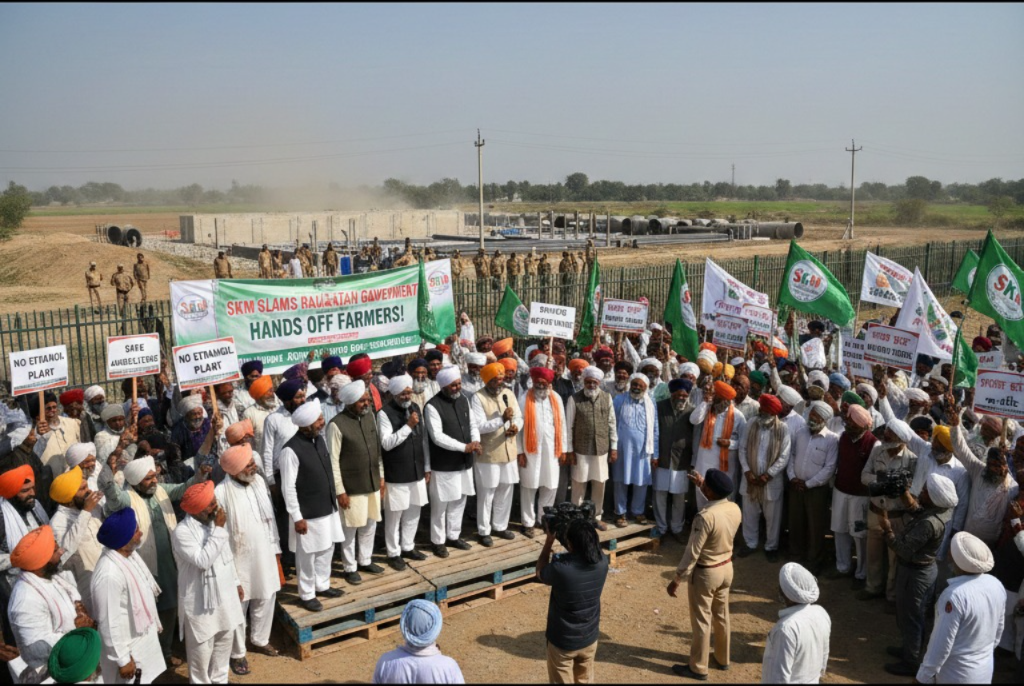
In recent weeks, Rajasthan’s Hanumangarh district has become the centre of attention across the country as farmers from several nearby villages have taken to the streets to protest against the construction of a grain-based ethanol plant. This protest has not only brought the issue of industrial expansion versus agricultural safety into focus but also raised questions about how development projects should balance economic progress with environmental protection. The Samyukt Kisan Morcha (SKM), a major farmers’ organization that led India’s nationwide farm protests in 2020–21, has strongly criticized the Rajasthan government for what it calls “an insensitive and forceful” response to the farmers’ demands.
The ethanol plant, being developed by a private company, is part of India’s national plan to promote biofuels. Ethanol is considered an eco-friendly alternative to petrol and diesel because it can reduce carbon emissions and support the government’s mission of green energy. However, farmers living near the plant site have voiced serious concerns. They believe that while the project may look beneficial on paper, its local effects could be disastrous. For people whose lives revolve around farming and livestock, the possibility of industrial pollution, chemical waste, and groundwater depletion poses a direct threat to their survival.
Farmers have stated that the ethanol plant could release waste material into the soil and water, contaminating the nearby agricultural fields and making them unsuitable for cultivation. Many villagers also fear that once the plant becomes operational, it will draw large amounts of groundwater for its processes, leaving less water available for irrigation. In a region like Rajasthan, where water is already scarce and every drop is precious, this concern cannot be ignored. Moreover, the possibility of air pollution due to ethanol vapors and industrial emissions has created anxiety among families living close to the construction site. They worry that such pollution could cause long-term health issues for children and elderly residents.
Tensions escalated when farmers tried to stop the construction work. Reports suggest that there were clashes between protestors and police, leading to injuries and property damage. In response, the local administration suspended internet services and deployed additional security forces to maintain order. The Samyukt Kisan Morcha condemned the government’s approach, saying that instead of using force, authorities should have opened a constructive dialogue with the farmers. The organization has demanded that the state conduct an independent environmental study before allowing further construction. It has also called for the release of detained protestors and has urged the government to respect the democratic right to peaceful protest.
Understanding Ethanol: Its Uses, Benefits, and Risks
To understand the depth of the farmers’ concerns, one must first understand what ethanol is and how it is produced. Ethanol, also known as ethyl alcohol, is a clear, flammable liquid made by fermenting natural substances like sugarcane, corn, or grains. In India, it is mainly produced for blending with petrol, which helps reduce dependence on imported crude oil. When mixed with petrol, ethanol acts as a cleaner-burning fuel, reducing harmful emissions from vehicles. The Indian government has ambitious targets to increase ethanol blending in fuel to promote environmental sustainability.
However, the process of manufacturing ethanol can have serious side effects if not managed properly. Ethanol production involves fermentation, distillation, and storage — all of which require large quantities of water and create waste products that must be carefully treated before being released into the environment. If safety protocols are not strictly followed, ethanol vapors can spread into the air, and untreated liquid waste can leak into the soil and water sources. Continuous exposure to ethanol fumes can affect the human body by irritating the eyes, nose, and throat and causing headaches and dizziness. Prolonged exposure may damage internal organs such as the liver and nervous system. For factory workers and residents nearby, such conditions can become a health hazard.
Ethanol is also highly flammable, which means that even a small mistake in handling or storage can result in a major accident. Therefore, industrial plants that produce ethanol must maintain strict safety standards, proper ventilation systems, and regular monitoring to ensure that there is no risk to the environment or human health. The farmers in Rajasthan are not opposing ethanol as a concept; they are opposing the unsafe implementation of such a project in an already water-stressed agricultural area without transparent environmental safeguards.
The Broader Environmental and Social Impact
The protest in Rajasthan is not just about one factory — it represents a deeper struggle between industrialization and rural livelihood. India’s progress depends on both, but when one threatens the other, conflict is inevitable. The farmers’ fears are rooted in real experiences from other parts of the country, where poorly managed industrial projects have caused pollution and long-term damage to agricultural ecosystems.
Ethanol plants, if not properly monitored, can discharge effluents that make the surrounding soil infertile. Once the soil is damaged, it takes years to recover, and farmers lose their only source of income. The groundwater contamination caused by chemical leakage can also affect drinking water sources, putting the entire community’s health at risk. In Rajasthan, where people already face extreme weather and limited water availability, such risks are magnified.
The situation also highlights the need for responsible governance. Development projects must be planned with community participation and transparency. Farmers have repeatedly said that they are not against progress; they simply want assurance that their health, water, and soil will remain safe. They are asking for fair environmental testing and public consultation before the project proceeds. Such demands are neither political nor extreme — they are rooted in common sense and the right to live in a clean, safe environment.
SKM’s Stand and Appeal to the Government
The Samyukt Kisan Morcha (SKM) has taken a firm stand in support of the protesting farmers. SKM leaders have said that the Rajasthan government’s actions — including the use of police force and temporary internet suspension — go against the spirit of democracy. They have appealed for a peaceful resolution and urged the government to listen to the farmers instead of treating them as troublemakers. According to SKM, the government should immediately halt construction, organize a detailed environmental and health study, and share its results publicly. Only after the findings prove that the project is safe should work be allowed to continue.
SKM also reminded the authorities that farmers are not opposing the idea of biofuel; in fact, they understand its national importance. However, when the same initiative threatens their local environment and livelihood, it becomes the government’s responsibility to find a balanced and sustainable solution.
Suganta Tutors’ Educational Insight
At Suganta Tutors, we believe that awareness begins with education. The protest in Rajasthan is not just a political incident — it is a living classroom that teaches valuable lessons about science, society, and sustainability. Understanding ethanol involves chemistry and environmental science, but understanding the protest involves empathy, civic sense, and social responsibility.
Suganta Tutors encourages students and teachers to explore such real-world issues. We aim to create a generation that learns not only from textbooks but also from the challenges unfolding in society. Our platform helps students connect with expert educators who explain topics like clean energy, environmental conservation, and the social impact of industrial development in simple, relatable ways.
We also invite universities and institutes to register on our platform to connect with verified tutors and students. By doing so, institutions can take part in building a network of learning that combines knowledge with awareness. Education is not just about gaining degrees — it is about understanding the world and contributing to its well-being. Suganta Tutors proudly supports this vision by turning education into a tool for awareness and positive change.
Frequently Asked Questions (FAQs)
Why are the farmers protesting against the ethanol plant in Rajasthan?
Farmers are protesting because they fear that the ethanol plant will cause pollution, reduce groundwater levels, and harm their farmlands. They believe that the project lacks transparency and proper environmental clearance, which could put their health and livelihood at risk.
What is ethanol and why is it important?
Ethanol is a type of alcohol made from agricultural products like sugarcane and grains. It is used as a biofuel and blended with petrol to reduce pollution. While ethanol helps the environment when used correctly, its production process can be harmful if industries ignore safety and waste management norms.
Is ethanol dangerous to humans?
Yes, ethanol can be dangerous if people are exposed to it for a long time. Its vapors can irritate the eyes, throat, and lungs, and its waste products can cause health problems when they contaminate water and soil. That’s why strict safety measures are necessary in ethanol factories.
What is SKM’s opinion about this protest?
The Samyukt Kisan Morcha (SKM) supports the farmers and has condemned the Rajasthan government’s response. They have demanded environmental studies, public transparency, and peaceful discussion to ensure that the plant does not harm local communities.
How does Suganta Tutors relate to this topic?
Suganta Tutors believes in spreading awareness through education. By learning about environmental issues, biofuels, and public movements, students can become more informed citizens. Suganta Tutors provides a platform where teachers and students connect to discuss such meaningful subjects and build knowledge that contributes to a better society.
How can educational institutions join Suganta Tutors?
Universities, colleges, and institutes can register directly on www.sugantatutors.com. After registration, they can connect with experienced teachers and verified students, join awareness programs, and make learning more practical and impactful.
Conclusion
The protest against the ethanol plant in Rajasthan is not an isolated event — it reflects the growing awareness among farmers about their rights, their land, and the environment. It is a reminder that real progress comes only when development respects both people and nature. Ethanol production is important for India’s future, but it must be done with care, transparency, and respect for those who live closest to its impact.
Education plays a vital role in shaping this awareness. Platforms like Suganta Tutors help young minds understand complex issues like this — where science, governance, and society meet. By learning, questioning, and understanding, students can become the voice of balance between progress and preservation.
Suganta Tutors continues its mission to connect learning with life, knowledge with awareness, and education with responsibility. Together, we can build a future that is both sustainable and humane — one where innovation uplifts everyone, without leaving anyone behind.
Suganta Tutors – Connect. Learn. Grow.
#SugantaTutors #FarmersProtest #RajasthanNews #EthanolPlant #SKM #EnvironmentalAwareness #EducationForAll #CleanEnergy #BiofuelIndia #HumanHealth #SustainableDevelopment




