Every city has a heart that keeps it alive — for Delhi-NCR, that heart beats silently in the form of the Aravalli Hills.
These ancient mountains, older than even the Himalayas, stretch across Gujarat, Rajasthan, Haryana, and Delhi, forming the backbone of North India’s ecology.
But while Delhi grows upward with concrete and glass, the Aravallis are shrinking — quietly losing their forests, rocks, and rivers to mining, construction, and neglect.
It’s easy to forget that these hills do far more than decorate the skyline — they clean Delhi’s air, recharge its water, and cool its climate. Without them, the city quite literally cannot breathe.
The Aravallis — Delhi’s Natural Shield
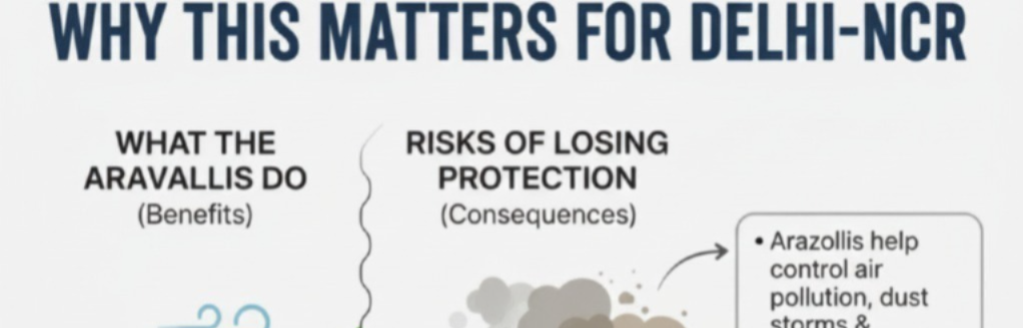
For centuries, the Aravalli range has stood as a protective wall between Delhi and the Thar Desert.
When hot, dusty winds try to travel from Rajasthan toward the capital, the Aravallis block them — reducing dust storms and controlling desertification.
Imagine Delhi without that shield:
The hot desert air would sweep freely across the plains, bringing more dust, dryness, and extreme heat. Summers would become unbearable, air quality would worsen, and the city would feel like an oven.
That’s why experts call the Aravallis Delhi’s “natural barrier” — a wall that defends the city’s air and soil from disaster.
The Lungs That Clean Delhi’s Air
Delhi is one of the most polluted cities in the world, with air quality often reaching hazardous levels. But the forested slopes of the Aravallis act as natural air purifiers, absorbing carbon dioxide and filtering harmful dust particles.
The trees and shrubs of this ancient range help reduce smog and pollution, and the gentle wind that passes through its forests carries cleaner air into the city.
Yet, with deforestation, illegal mining, and encroachments eating away at this green shield, Delhi’s “lungs” are collapsing. Every lost patch of forest means less oxygen and more dust in the air.
If the Aravallis disappear, Delhi will be gasping for breath — not metaphorically, but literally.
The Hidden Water Tank of the Capital
Most people don’t realize that beneath the rocky ridges of the Aravallis lies one of North India’s most important groundwater recharge systems.
When it rains, water seeps deep into the cracks and pores of the Aravalli rocks, refilling underground aquifers that supply wells and borewells across Delhi, Gurugram, and Faridabad.
If the Aravallis vanish, this natural recharge process will break. Rainwater will simply flow away instead of soaking into the ground — leading to flooding during monsoons and drought during summers.
Already, experts warn that Delhi’s groundwater levels are falling at an alarming rate, and destroying the Aravalli recharge zones will only make things worse.
So when we say “the Aravallis keep Delhi alive,” it isn’t poetic — it’s pure science.
A Home to Life — and Hope
Beyond the trees and rocks, the Aravallis are alive with biodiversity.
From leopards and blue bulls to peacocks and migratory birds, these hills form an ecological web that keeps the region balanced.
The Asola Bhatti Wildlife Sanctuary near Delhi, part of the Aravalli range, is home to over 200 bird species and dozens of mammals and reptiles. These animals depend on the forests for shelter and food — and in return, they help maintain nature’s cycle.
If we lose these forests, it’s not just wildlife that suffers — it’s humanity too. Every vanished species takes away a piece of the ecosystem that sustains life on Earth.
The Climate Regulator of Delhi-NCR
The Aravallis help stabilize the local climate. They absorb heat during the day and release it slowly at night, keeping nearby areas cooler.
Their green cover helps maintain humidity and supports rainfall patterns.
But when trees are cut and hills are flattened for construction, the land loses its ability to regulate temperature — causing urban heat islands, where concrete traps heat and cities stay unbearably hot even at night.
If this continues, Delhi’s summer temperatures could rise by several degrees, turning the city into a furnace.
Protecting the Aravallis means protecting Delhi from its own man-made heat.
The Growing Threat
Over the past few decades, illegal mining, deforestation, and rapid urban expansion have eaten away large portions of the Aravalli range.
Entire hills have been flattened, trees uprooted, and natural drainage lines destroyed.
Recent debates — such as the Supreme Court’s 100-metre elevation rule — have further worried environmentalists, as they fear it will remove legal protection from most of the Aravalli area, leaving it open to mining and construction.
Experts warn that if such trends continue, Delhi could face a severe environmental collapse in the next decade — with hotter summers, dirtier air, and no groundwater.
The future of Delhi depends on the fate of the Aravallis.
Suganta Tutors: Creating Awareness Through Education
At Suganta Tutors, we believe that protecting the environment begins with knowledge and awareness.
Students are the future — and the more they understand how nature works, the better they can protect it.
Our verified and qualified teachers help students explore real-world topics like the Aravalli Hills, climate change, deforestation, and sustainable development in an easy, relatable way.
When a student learns how the Aravallis clean Delhi’s air or store its water, they don’t just memorize facts — they build empathy and understanding for the planet.
Suganta Tutors encourages every learner to think beyond exams — to learn how their choices impact the Earth, and how they can make a difference.
Because when education meets awareness, change becomes possible.
The Way Forward: Saving Delhi’s Natural Lifeline
Protecting the Aravallis is not just about saving mountains — it’s about saving people.
Delhi cannot breathe, drink, or stay cool without these hills.
Experts and activists are calling for:
Strict bans on illegal mining and encroachment
Large-scale afforestation using native trees
Environmental education programs in schools
Stronger laws that protect low-lying Aravalli zones
Public participation through clean-up and plantation drives
But beyond policies and protests, what we need most is awareness — understanding that every tree cut and every hill destroyed affects our lives directly.
If Delhi is to have a sustainable future, the Aravallis must be treated not as land to exploit, but as life to protect.
Frequently Asked Questions (FAQs)
Q1. Why are the Aravalli Hills so important for Delhi-NCR?
Because they protect Delhi from desert winds, recharge its groundwater, reduce heat, and improve air quality — making life in the region possible.
Q2. How do the Aravallis help in controlling air pollution?
The forests act as natural filters, trapping dust and absorbing carbon dioxide, helping clean Delhi’s polluted air.
Q3. What happens if the Aravallis disappear?
Delhi will face worse dust storms, water shortages, heat waves, and dangerously poor air quality — creating an unlivable environment.
Q4. How is human activity damaging the Aravallis?
Illegal mining, construction, and deforestation are removing forest cover and breaking natural water recharge systems.
Q5. How does Suganta Tutors help students learn about such issues?
Through real-world learning, Suganta Tutors connects students with verified educators who teach about environment, geography, and sustainability — helping them become aware, responsible citizens.
Conclusion
The Aravalli Hills are not just mountains — they are Delhi’s lungs, shield, and water source.
They silently protect millions from pollution, heat, and drought. Yet, their silence has also made it easier to ignore them.
It’s time to listen.
Every citizen, student, and policymaker must realize that without the Aravallis, Delhi cannot survive.
Through education, awareness, and action, we can restore what has been lost and preserve what still stands.
Let’s promise to protect the mountains that keep our capital — and our future — alive.
Learn. Understand. Act — with Suganta Tutors.