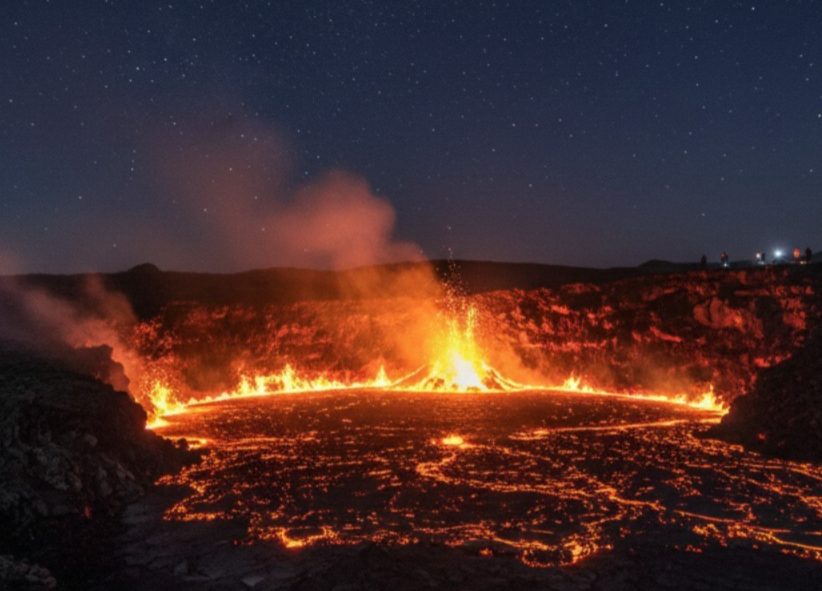
A volcano in Ethiopia, named Hayli Gubbi, made headlines worldwide when it erupted after lying silent for an estimated 10,000 to 12,000 years. This wasn't just a local firework show; the explosion was powerful enough to shoot a massive cloud of ash and gas 14 to 15 kilometers high, right into the highway of global wind currents.
This event proved that in our interconnected world, a disaster in the East African Rift can cause major disruptions thousands of kilometers away—with the resulting pollution cloud traveling directly across the Arabian Sea and passing right over India's skies.
What Caused This Giant to Wake Up?
Hayli Gubbi is located in the East African Rift System, a vast, geologically volatile region where the African continent is slowly being pulled apart. This separation creates huge, deep cracks in the Earth's crust.
Pressure Cooker: For over ten millennia, immense pressure built up beneath the volcano. The resulting eruption was explosive, not a gentle lava flow.
The Toxic Cloud: The blast sent a cocktail of materials soaring: fine ash (microscopic glass shards), pulverized rock, and huge volumes of sulfur dioxide ($\text{SO}_2$) gas. The sheer force launched these materials high enough to bypass local weather systems and tap into global atmospheric circulation.
The Effects on Animals and Communities
The immediate disaster was felt most intensely by the local communities and wildlife in the Afar region of Ethiopia:
Livestock Disaster: For the local pastoral communities, whose lives rely entirely on their livestock (goats, cows, etc.), the consequences were devastating. The thick, abrasive ash blanketed grazing lands and contaminated all water sources. This resulted in immediate illness and a long-term threat of starvation for thousands of animals.
Wildlife Impact: Birds flying at lower altitudes were at risk of asphyxiation (suffocation) and disorientation. All local wildlife faced severe habitat destruction and poisoning from the contaminated food chain, potentially leading to long-term population collapse in the area.
The Pollution Cloud’s Journey to India
The pollution did not stay in Africa. The cloud was captured by the high-speed jet stream winds and traveled over 4,000 kilometers across the Red Sea and the Arabian Peninsula, racing toward the Indian subcontinent at speeds up to 120 km/h.
India's Primary Threat: Aviation Safety: The most immediate danger for India was not air quality, but flight operations. Volcanic ash is a nightmare for commercial aircraft because the glass shards melt inside the engines and can cause total engine failure. This forced the Directorate General of Civil Aviation (DGCA) to issue urgent alerts.
The Consequence: Numerous international flights from and to major hubs like Mumbai and Delhi were forced to cancel or reroute to avoid the affected high-altitude corridors, causing massive travel disruptions.
Good News on Ground Air Quality: Crucially, Indian experts confirmed the ash plume remained high up (10–15 km altitude). This meant it did not worsen the ground-level air quality (AQI) in Indian cities, though it may have made the skies look slightly hazier.
The Long-Term Shadow and Global Concerns
While the ash eventually dissipated, the massive injection of $\text{SO}_2$ gas into the atmosphere raises two critical long-term concerns:
Temporary Climate Cooling: The $\text{SO}_2$ forms tiny droplets of sulfuric acid called sulfate aerosols. These aerosols act like a giant, reflective shield, bouncing sunlight back into space. This can lead to a minor, temporary global cooling effect for up to a year.
Acid Deposition Risk: As the plume eventually drifts eastward, sulfur compounds can settle over regions like the Himalayas. This can contribute to acid deposition (acid rain/snow), which harms fragile mountain ecosystems and potentially impacts the quality of major river headwaters.
Need Help Understanding the Science? SuGanta Can Guide You
In the face of complex global events like the Hayli Gubbi eruption—which involves understanding plate tectonics, atmospheric physics, and environmental impact—quality education is essential to separate fact from speculation. SuGanta.com, India's Verified Tutor Platform, is here to help you gain clarity. We connect you with 100% verified tutors who offer personalized learning plans in subjects like Environmental Science, Geology, and Geography. Whether you need a nearby home tutor for focused study or flexible online classes, SuGanta ensures affordable access to expert guidance, empowering you to understand the scientific principles behind the world's biggest challenges.
Find the perfect tutor near you: CLICK NOW
Join SuGanta today: CLICK HERE
Q1: What is Hayli Gubbi — and what happened?
Hayli Gubbi is a shield-type volcano located in the Afar Region of northeastern Ethiopia, inside the geologically active East African Rift System.
On 23 November 2025, Hayli Gubbi erupted for the first time in about 12,000 years — the longest-known dormancy in recent geological records.
The eruption was explosive (sub-Plinian), releasing a large ash plume, volcanic dust, fine rock/glass particles, and gases (including sulphur dioxide). There was no major lava flow.
Q2: How did the ash plume travel — and why did it reach India?
The eruption sent ash and gases high into the atmosphere — up to 10–15 km (approx. 33,000–45,000 ft) — reaching altitudes frequently used by commercial aircraft.
Strong upper-air winds carried the plume from Ethiopia across the Red Sea → the Arabian Peninsula (Yemen, Oman) → over the Arabian Sea → and then toward western and northern India.
Satellite tracking and atmospheric data confirmed the plume’s 4,600 km-plus journey over ~2 days.
Q3: What impact did this have in India — especially air travel & air quality?
The plume entered Indian airspace over western India, moved across states including Gujarat, Rajasthan, Maharashtra, then onto northern belt — including Delhi-NCR, Punjab, Haryana and Uttar Pradesh.
Because volcanic ash and sulphur dioxide in the upper atmosphere pose serious hazards to aircraft — jet engines, visibility, air filters — the Directorate General of Civil Aviation (DGCA) issued advisories. Several airlines, including Air India and Akasa Air, canceled or delayed dozens of flights — both international and domestic.
According to the India Meteorological Department (IMD), the ash plume remained in the upper troposphere, and did not significantly affect surface-level air quality or weather in India.
By late Tuesday (25 Nov 2025), the plume had largely moved out of Indian skies, with forecasts suggesting it would drift further toward China.
Q4: Were there any health risks for people in India (especially in Delhi)?
Volcanic ash consists of fine, often microscopic particles that — in principle — can irritate respiratory systems, especially for vulnerable people (children, elderly, asthma sufferers).
However: because the ash plume was mostly high up in the atmosphere, it didn’t settle significantly at ground level. According to IMD and air-quality monitoring by independent analysts, there was no measurable deterioration in surface-level air quality in Delhi attributable to the eruption.
In short: no major or long-lasting health impact is expected for people on the ground, though authorities recommended caution — especially for sensitive individuals — given the unusual event.
Q5: Could this eruption affect Indian weather or climate (e.g. monsoon, rainfall, longer-term effects)?
Some experts noted that volcanic eruptions releasing sulphur dioxide (SO₂) can — in principle — influence regional or even global climate over months, via aerosol effects, sunlight scattering, or cloud microphysics.
However: most analyses after this eruption conclude that global or regional climate impact is likely to be minor, given the scale of eruption and the fact that the ash plume remained mostly aloft and dispersed widely — reducing surface-level fallout.
For now: there is no indication that Indian monsoon patterns, long-term rainfall or climate cycles will be affected by this event.