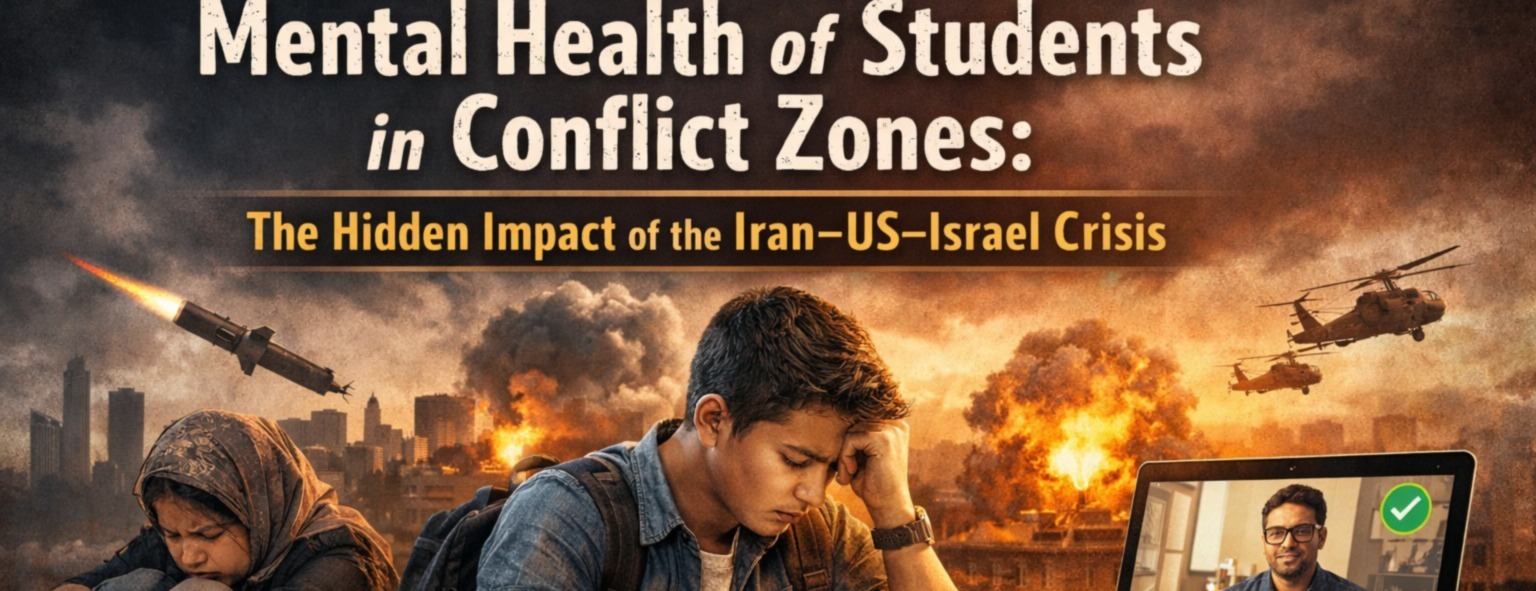
War is often discussed in terms of borders, governments, military actions, and global politics. News headlines focus on missiles, diplomatic meetings, and international reactions. But there is another side of war that rarely gets enough attention — the emotional and psychological impact on ordinary people, especially students.
When tensions rise between countries like Iran, the United States, and Israel, the consequences are not limited to political leaders or soldiers. They reach classrooms, hostels, study rooms, and even the quiet corners where students try to focus on their future. Young minds, already carrying academic pressure and personal growth challenges, suddenly have to process fear, uncertainty, and instability.
This blog explores in simple and humanized words how the Iran–US–Israel crisis is affecting the mental health of students, especially those living in or connected to conflict zones. It also explains how stress, fear, and anxiety can lead to academic setbacks, and how families, institutions, and platforms like Suganta Tutors can provide support through online classes and verified teachers during such uncertain times.
Understanding the Emotional Impact of Conflict on Students
Students are in a sensitive stage of life. They are building their identity, setting goals, preparing for exams, and planning careers. Stability and routine are essential for them. When conflict disrupts daily life, the impact is not just physical — it deeply affects mental well-being.
In conflict zones or regions affected by tension, students often experience a constant sense of alertness. They may hear news about airstrikes, military retaliation, travel bans, or security threats. Even if they are not directly in danger, exposure to such information creates fear and uncertainty.
The human brain responds to perceived danger by activating stress hormones. In small doses, stress can help someone stay alert. But when stress becomes continuous, it turns harmful. Students begin to feel restless, anxious, and emotionally drained. Concentration becomes difficult. Sleep patterns are disturbed. Small academic challenges start feeling overwhelming.
The Iran–US–Israel crisis has led to travel disruptions, flight cancellations, and campus security concerns. Students studying in affected regions or with families connected to those regions are constantly worried about safety. Some international students, including Indian students, have reported feeling trapped or unsure about their return plans. That uncertainty alone is enough to create long-term anxiety.
Fear and Anxiety: The Silent Burden
Fear during conflict is not always loud. It often hides quietly inside students. A student may attend online classes but still feel distracted. They may open a textbook but struggle to absorb information. They may appear normal outwardly while internally battling racing thoughts.
Anxiety in such situations usually comes from unanswered questions:
Will my campus close?
Will exams be postponed?
Is my family safe?
Will flights operate normally?
What if the situation gets worse?
When these thoughts repeat daily, the brain remains in survival mode. In survival mode, learning becomes difficult because the brain prioritizes safety over academic focus.
Some students also develop what psychologists call “anticipatory anxiety.” They constantly imagine worst-case scenarios. Even if nothing immediately dangerous happens, their mind prepares for disaster. Over time, this drains emotional energy and reduces motivation.
This emotional exhaustion often results in academic setbacks. Grades may drop. Assignments may be delayed. Students may feel guilty for not performing well, which further increases stress.
Academic Disruption and Emotional Instability
Education depends heavily on routine and structure. When conflict disrupts schools or universities, that structure breaks. Some institutions move to online classes for safety reasons. While digital learning is a helpful solution, it also requires self-discipline and emotional stability.
Imagine a student attending an online lecture while simultaneously checking news updates about nearby unrest. Their body may be sitting in front of a screen, but their mind is somewhere else — thinking about safety, family, or travel concerns.
The shift from physical classrooms to online classes can feel isolating. Students lose daily interaction with friends and teachers. Social support decreases. Loneliness increases. In conflict zones, internet connectivity may also become unstable, creating additional frustration.
This combination of emotional distress and academic disruption creates a cycle. Poor concentration leads to incomplete learning. Incomplete learning increases exam anxiety. Exam anxiety reduces confidence. Reduced confidence affects mental health further.
Breaking this cycle requires intentional support.
Real Emotional Experiences of Students
In times of geopolitical tension like the Iran–US–Israel crisis, many students report feeling disconnected from their goals. For example, a student preparing for medical entrance exams may suddenly feel that studying chemistry reactions is meaningless compared to global conflict news. Another student planning to study abroad may worry about visa delays or travel safety.
Some students studying in the Middle East have described the emotional pressure of hearing sirens or security warnings while preparing for exams. Even students living far away but with relatives in affected regions feel helpless and anxious.
The emotional toll does not always appear immediately. Sometimes students seem fine for weeks, but gradually they begin to show signs of burnout, irritability, or withdrawal from social activities.
Mental health experts often say that prolonged uncertainty is more exhausting than immediate danger. When students do not know how long instability will last, their brain struggles to relax.
The Role of Families During Conflict
Families play a powerful role in protecting students’ mental health. Parents often experience fear themselves, but it is important to create a calm environment at home.
Open communication is essential. Instead of hiding concerns, families should discuss them honestly but gently. When students feel heard, their emotional burden becomes lighter.
Parents should also avoid pressuring students about academic performance during crisis situations. Encouragement works better than comparison. Saying “Do your best, we understand this is difficult” builds confidence. Saying “You must not let this affect your grades” increases stress.
If a student is studying abroad, regular communication becomes even more important. Even short daily calls or messages can provide emotional reassurance.
Coping Strategies for Students
Students cannot control geopolitical events, but they can control how they respond emotionally. Developing coping habits can make a significant difference.
Creating a daily routine helps bring back structure. Even if classes are online, waking up at a fixed time, setting study hours, taking breaks, and sleeping on time stabilizes the mind.
Limiting exposure to constant news updates reduces anxiety. Checking reliable news sources once or twice a day is healthier than scrolling endlessly.
Practicing deep breathing or mindfulness exercises calms the nervous system. Physical activity, even simple stretching or walking indoors, reduces stress hormones.
Talking openly with friends or counselors helps release emotional tension. Suppressing fear usually makes it stronger.
How Suganta Tutors Supports Students During Crisis
In times of instability, consistent academic support becomes more important than ever. Suganta Tutors provides structured online classes with verified teachers who understand not only subject concepts but also student psychology.
When schools shift schedules or exams are postponed, students often feel lost. Suganta Tutors helps them regain clarity by creating personalized study plans. Verified teachers offer one-to-one guidance, helping students focus on achievable goals rather than overwhelming tasks.
Online classes ensure continuity. Even if physical campuses close, learning does not have to stop. Having a trusted teacher regularly checking progress creates a sense of stability.
Beyond academics, supportive teaching builds emotional reassurance. When a teacher understands that a student is stressed and adjusts the pace accordingly, it reduces pressure.
In crisis times, education should not feel like punishment. It should feel like support. That is where platforms with verified teachers make a real difference.
Long-Term Mental Health Concerns
If emotional stress continues without support, it may develop into more serious conditions such as chronic anxiety or depression. Early signs include:
Persistent sadness
Loss of interest in studies
Irritability
Sleep disturbances
Changes in appetite
Feeling hopeless about the future
Recognizing these signs early allows families to seek professional help.
It is important to remember that asking for help is not weakness. Counseling, therapy, or support groups can provide valuable coping tools.
The Importance of Community and Hope
Conflict may disrupt daily life, but it does not have to destroy dreams. Throughout history, students have continued learning even during difficult times.
Community support — whether through family, friends, teachers, or online educational platforms — strengthens resilience.
Hope plays a major role in mental recovery. Students who believe that instability is temporary are more likely to maintain motivation. Encouraging stories of recovery and resilience remind them that crises eventually pass.
Final Thoughts
The Iran–US–Israel crisis reminds us that global conflicts are not distant events. They influence the emotional well-being of students around the world. Fear, anxiety, and academic disruption are real challenges.
However, with supportive families, structured routines, mental health awareness, and platforms like Suganta Tutors offering online classes with verified teachers, students can continue their education while protecting their emotional health.
Education should remain a source of stability even in unstable times. By addressing mental health openly and compassionately, we ensure that students not only survive crises but emerge stronger and more resilient.
Frequently Asked Questions (FAQs)
How does conflict like the Iran–US–Israel crisis affect students mentally?
It increases stress, anxiety, and fear due to uncertainty, safety concerns, and disrupted routines. Continuous exposure to such stress can reduce concentration and emotional stability.
Can online classes really help during conflict?
Yes. Online classes provide continuity and structure. With verified teachers, students receive consistent guidance and emotional reassurance even when physical schools close.
What should parents do if their child seems anxious?
Listen without judgment, maintain calm communication, reduce news exposure, and seek professional counseling if anxiety persists.
How can Suganta Tutors help students in conflict zones?
Suganta Tutors offers personalized academic plans, structured online classes, and verified teachers who help students stay focused and emotionally supported during uncertain times.
Is it normal to feel distracted during global crises?
Yes. Emotional reactions to instability are natural. Recognizing them and adopting healthy coping strategies is important.




